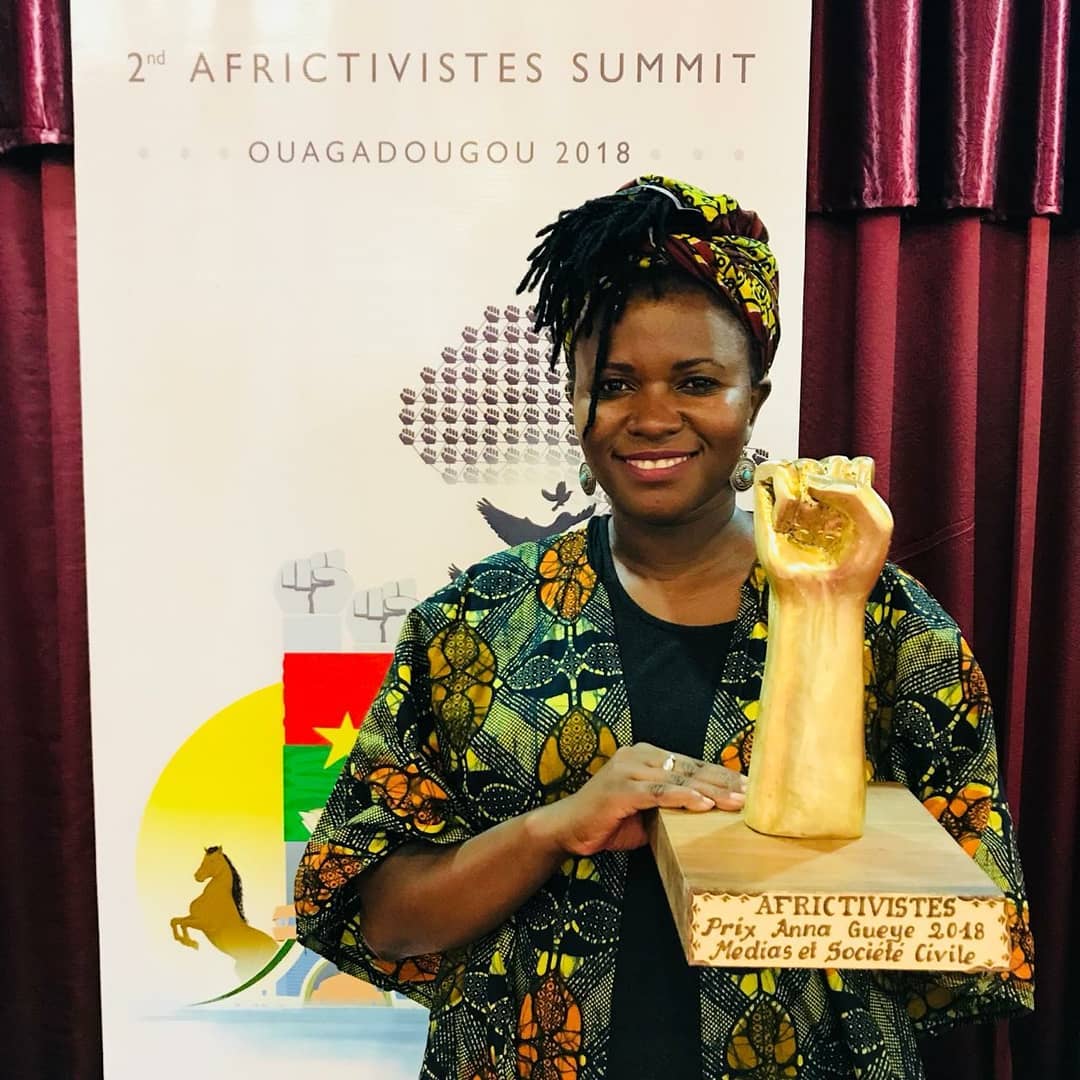
Rosebell Kagumire, the Ugandan winner of the 2018 AfricTivistes Prize
Rosebell Kagumire is a feminist writer, communications specialist and activist. She is the curator and editor-in-chief of African Feminism, an online platform that brings together feminist writers and activists from across Africa.
Rosebell is a board member of the Nalafem collective, where, in 2022, she co-authored the book *I am Nala*, which explores the struggle for reproductive justice. She has co-edited a book: *Challenging Patriarchy: The Role of Patriarchy in the Roll-Back of Democracy in East and Horn of Africa*. Rosebell sits on the advisory board of the Centre for Feminist Foreign Policy and was recognised by Avance Media as one of Africa’s 100 most influential women in its 2021 edition.
She has expertise in media, gender, peace and conflict, social responsibility, active citizenship, women’s empowerment, migrants’ rights and social justice. Rosebell was awarded the 2018 Anna Gueye Prize by Africtivistes, a network of African democracy activists, for her contributions to digital democracy, justice and equality on the African continent.
The World Economic Forum has recognised Rosebell as one of the World’s Young Leaders under 40. She holds a Master’s degree in Media, Peace and Conflict Studies from the United Nations-mandated University for Peace in Costa Rica. She has undertaken short courses on non-violent conflict at the Fletcher School and on global leadership and public policy at the Harvard Kennedy School. She holds an undergraduate degree in mass communication from Makerere University in Uganda.
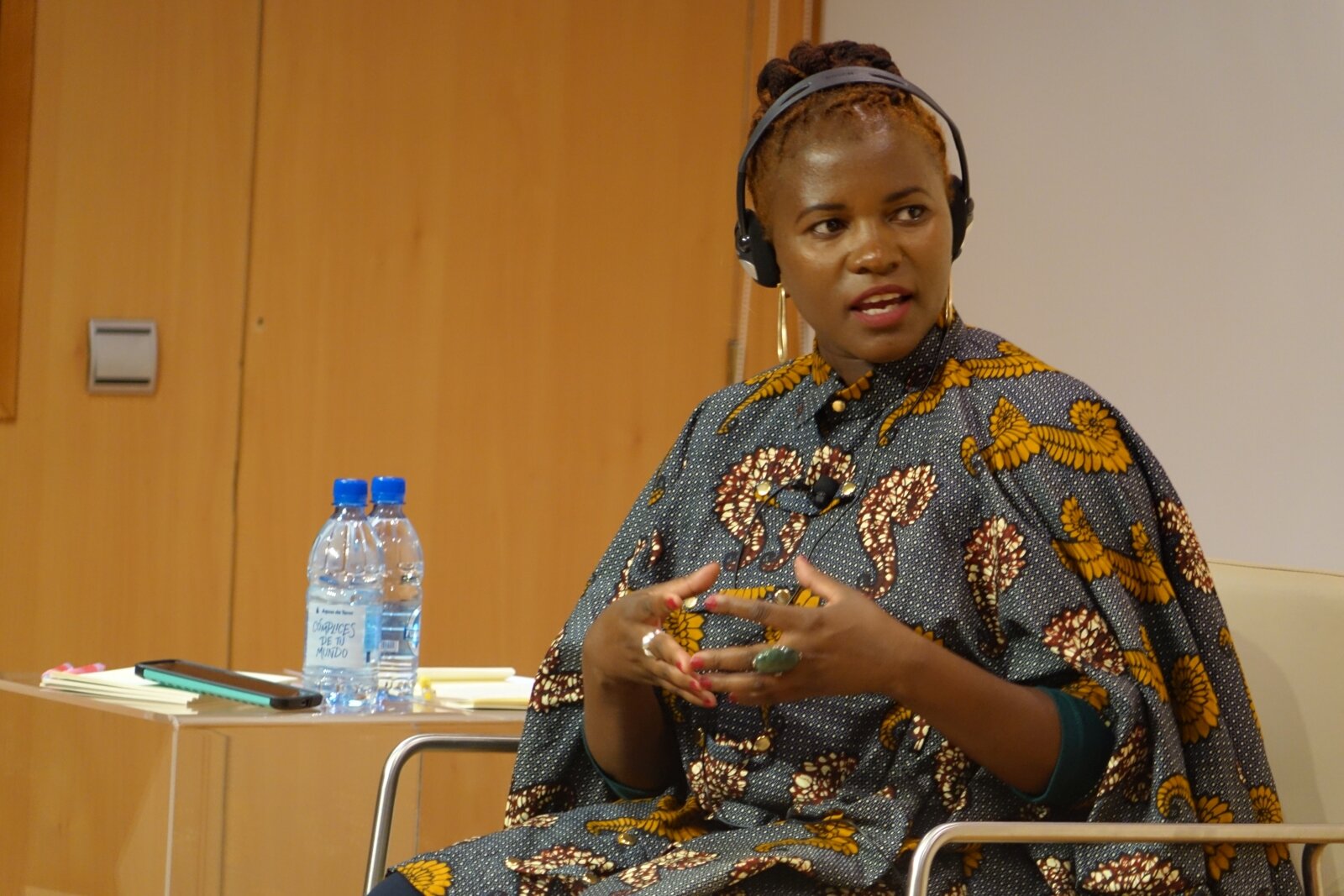
AfricTivistes: Ms Kagumire, as a writer and feminist activist, can you tell us what sparked your activism?AfricTivistes: Ms Kagumire, as a writer and feminist activist, can you tell us what sparked your activism?
Rosebell Kagumire: Activism is a process; it really is a collective endeavour. It all began when someone gave me the opportunity to form my own opinions as a child, and to express myself from a very young age. I then studied journalism and worked as a journalist, which opened my eyes, in my early twenties, to the different realities people face in my country, and to the structures that determine who succeeds and who doesn’t. I also learnt about the power of the media – the power that telling a story can have to shed light on people’s realities and, at times, to bring about change. Freedom of expression and the threats to it have shown me why it is important to speak out and organise beyond the private sphere. It was through my work in the media that I also realised that simply telling the story would not be enough. It is important to stand alongside people and actively work together to find ways to improve our circumstances or to hold to account those who fail in their day-to-day duties.
Has your activism cost you anything in life?
Taking a stand often means alienating certain people, but it also means opening yourself up to a new community. It has sometimes been difficult to find work, as we operate in a culture where various economic and political interests co-opt spaces and where widespread complacency prevents change from happening. At times, I’ve been dismissed as ‘she’s too much’ whilst looking for opportunities, but that only serves to spur me on to be that ‘too much’, because we have to be too much for the systems to change. I’ve faced certain threats which I’ve managed to mitigate with help. But often, what nobody prepares you for is the impact this work has on your mental health, and I’ve had to step back from certain activities when I felt I could no longer cope with them.
What are the main feminist demands in Africa?
Africans find themselves at a poignant juncture where we have barely decolonised what the colonisers left behind – from political and economic institutions and models to social norms and prejudices. Consequently, we see a state still engaged in perpetuating colonial violence, denying civil liberties, depriving us of economic rights, organising sham elections against the will of the people, and putting on a show rather than tackling the inequality that decades of colonisation have imposed on Africans and the specific ways in which gendered power has been constructed, from communities to men and patriarchy in most spheres of our lives.
Decision-making on this continent is still largely in the hands of a few violent and ill-equipped power-holders. Ill-equipped to think and act in the continent’s best interests at a time when the world’s imperial powers are returning to the fray to lay claim to the rest of our labour force and our resources. The focus should be on combating militarism – where we spend more on weapons than on education and our own health infrastructure – which plays into the hands of the global empires responsible for many of the conflicts on the continent that have led to the displacement of millions of people and weakened our economies.
The most urgent call is for the implementation of a policy aimed at dismantling the African colonial state as it still exists and at creating space for new visions of how we can exist, organise ourselves and live as a people. To guarantee Africans the right to freedom of movement and equal opportunities, it is necessary to create a space of freedom and autonomy.
As an active African citizen, what is your view on the state of democracy in African countries?
As I said earlier, we have never experienced democracy in the states established by the colonisers. Although we have seen a few moments of hope and progress on certain issues and in certain countries, the state of democracy remains as dire as ever today. The distortion of ethics and liberation ideologies following independence, with the aim of erasing the role and contribution of women in liberating the continent from colonial forces, remains a problem. The position of women in most countries remains problematic, with many parliaments debating issues relating to women’s bodies and safety to their detriment.
Power and resources are always in the hands of a small number of people (often men) who use these community and state resources to deny any semblance of the will of the people. Who does economic growth benefit?
In most countries, young people under the age of 25 make up the majority of the population and, unless there are major changes in the way the country is governed, we should prepare ourselves for periods of unrest and protest – all of which are necessary to dislodge the power currently held by elderly men who have enriched themselves at the expense of their communities and the country. We have already witnessed the rise of the pan-African feminist organisation and of young people from various countries who are protesting against the status quo and proposing a different path.
We have seen many countries interpret gender equality and inclusion as simply increasing the number of people involved, without any change in the balance of power. It is not enough to represent a group; the power that group acquires through the few representatives we have is not very significant. The structure of the state and the behaviour of those in power in African states cannot guarantee democracy and have almost never done so. The resurgence of militarism and the militarisation of state institutions and responses to unrest threaten our security and our future.
We see more rulers than leaders outsourcing the brutal control of countries through military and economic agreements with nations possessing military and imperial power, in order to ensure that nothing matters in our elections and nation-building processes. But all marginalised people – whether young people, women or people of different genders – have always fought to secure their place in society, and this struggle will continue, particularly at a time when many countries are going back on their promises of equality and respect for the will of the people.
In 2018, at the third AfricTivistes summit in Ouagadougou, you were awarded the Anna Gueye Prize for your civic engagement. What does this recognition mean to you?
I was honoured to receive an award in memory of someone I deeply admired and one of the great pioneers of online organising and storytelling. The award was a recognition of my work and a reminder to continue building on the foundations laid by my fellow activists, both in life and in death. This is important at a time when online spaces are at the heart of many positive changes in society, but also of new threats to marginalised people. It has renewed my determination to carry on.
What advice would you give to women who want to make gender equality a reality in Africa?
I would say to young Africans, regardless of their gender, ethnicity or sexual orientation, that it is important to invest in knowledge – our knowledge of the past, and not just the colonial narratives that the media and our education systems continue to perpetuate. We need to understand our own ethics and our ways of ensuring dignity for all, and how our existence is interconnected. We must continue to seek knowledge, especially in these times of widespread misinformation. Without the pursuit of knowledge, our energy is wasted on narrow struggles and we go round in circles. Audre Lorde said: “There is no single-issue struggle because we do not live single-issue lives.” The struggle, therefore, is for all Africans to be seen and treated as equals and as whole people in all their multiple identities. Winnie Madikizela-Mandela said: “I am not the sort of person who wears pretty flowers and is an ornament for everyone.”
We must refuse to be used as mere window dressing by those in power; refuse to be merely seen and not heard; and reject the portrayals and notions that deprive you of space, power and dignity – from the home to the workplace, on the streets and in the other corridors of power.
Follow Rosebell Kagumire on:
By Ndeye Fatou Diouf, Digital Content Manager at AfricTivistes