The decline of democracy in French-speaking West Africa: civil society sets out its recommendations
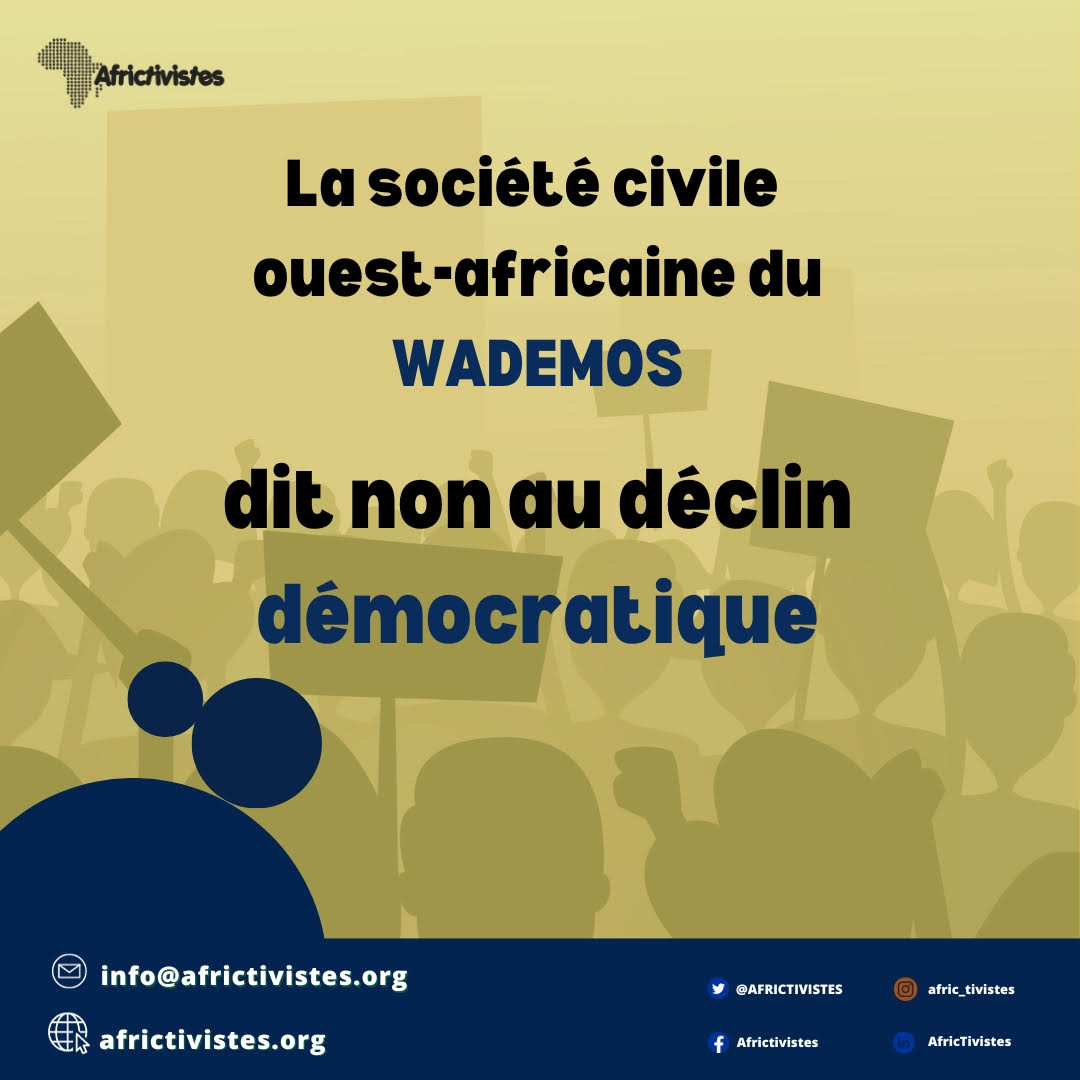
Recently, “democratic” overthrows and untimely coups d’état have become commonplace in Africa, particularly in French-speaking West Africa. To address this phenomenon, the Network of Solidarity for Democracy in West Africa (WADEMOS) organised a regional multiparty conference in Abidjan, Côte d’Ivoire, from 1st to 2nd August 2023, which focused on discussing democratic decline and political transitions in French-speaking West Africa. Following discussions that included Cheikh Fall, president of AfricTivistes, several recommendations were made to promote and safeguard democratic achievements for the benefit of, among other stakeholders, the Economic Community of West African States (ECOWAS), civil society, and local populations.
With the military takeover in Niger, West Africa is mired in a worrying cycle of “constant democratic overthrows.” Over the past three years, six coups d’état have occurred in French-speaking West Africa: two in Mali in 2020 and 2021, one in Guinea in 2021, two in Burkina Faso in 2022, and one in Niger in 2023. It is also worth noting that in the West African region, there were two attempted coups in Guinea-Bissau and Gambia in 2022.
These coups d’état have been recorded in a context of “widespread contempt for political and civil liberties,” associated with an “escalation of insecurity and growing economic difficulties,” as stated in the final declaration of the WADEMOS regional conference. Experts in democracy and governance from the West African region, as well as senior officials from the ECOWAS Commission, pro-democracy actors, and democracy and governance experts participated in the conference.
While moderating the roundtable on the “Decline of Democracy in Francophone Africa,” the president of AfricTivistes, Cheikh Fall, called upon the speakers to address the decay and breakdown of trust in representative democracies, the absence of states, and the feelings of abandonment that fuel separatist ambitions or security crises, among other current issues.
The speakers included: Ibrahima Kane, a lawyer and special advisor at the Open Society Foundation, responsible for the African Union programme with in-depth knowledge of the socio-political dynamics in Africa; Mathias Hounkpe, an expert in promoting elections and good governance in the sub-region; Augustin Loada, an academic who has contributed to several studies on governance, political dynamics, and democracy in the region; Aissatou Kanté, a researcher at the regional office of the Institute for Security Studies (ISS) who conducts significant work on coups d’état; and Lassane Ouedraogo, a doctor of arts and media studies, teacher and researcher on media education, representation and identity, Islam, non-state groups, and social change.
This roundtable provided an opportunity for the speakers to share their experiences and offer recommendations and potential solutions.
For the various actors who participated in this multiparty conference, it is essential to consider a number of factors to understand this situation. Among these factors, they cite “growing dissatisfaction among West African citizens regarding the processes and outcomes of democratic governance, contrary to popular expectations that democracy would enhance the economic well-being of ordinary citizens,” as noted in the document.
To these facilitating factors, they add, “the return of military coups, the manipulation of constitutions and election results for the prolongation of mandates, the threat of violent extremism, particularly in the Sahel, and the emergence of external forces and influences that have brought a halt to the initial progress made in democratisation and democratic consolidation in French-speaking West Africa,” lamenting this recent “wave” which is “the most alarming” of the last decade.
However, the actors and experts argue that at the regional level, support for democracy and democratic governance remains “high.” This is despite a growing “dissatisfaction” regarding the state of democratic governance over the last decade, particularly in French-speaking countries, they note. They do, however, recognise the “efforts made by ECOWAS to, on the one hand, strengthen resilience against the main threats and overthrows encountered within the region.” On the other hand, efforts are being made to revise the “Regional Protocol on Democracy and Good Governance; particularly by imposing term limits in West Africa, and by strengthening regional security and stability, including unconstitutional changes of government in West Africa.”
It is important to note that the WADEMOS network is a transnational network of democratic solidarity, non-partisan and independent, led by civil society and composed of over thirty-five (35) civil society organisations located in 15 countries in West Africa. The objective of the WADEMOS network is to mobilise, coordinate, and harness the collective power of civil society and other pro-democracy actors, resources, and opportunities within the West African region to advance, defend, and revitalise democracy and promote democratic norms and reforms in the sub-region.
Recommendations from the Abidjan Conference for a Return to Democratic Governance
Thus, the discussions led to a series of recommendations aimed at ending democratic decline through “reflections on its triggering factors” and on the “intervention strategies for current transition processes in French-speaking West Africa.” For a return to democratic governance in the countries of French-speaking West Africa, the conference participants demand, among other things, to:
- Facilitate an inclusive political dialogue involving all stakeholders, including political parties, civil society, religious groups, women’s groups, and marginalised communities.
- Provide support and protection to CSOs working to promote human rights, democracy, and good governance. These organisations play a crucial role in promoting democratic reforms and holding governments accountable.
- The need to free oneself from the persistent colonial influence and to adopt a more endogenous approach to democracy in West Africa while promoting civic education for democracy.
- Military juntas must involve civil society, political parties, youth, women, and minority communities in the transition process. Including all voices will strengthen the legitimacy of decisions made and create a sense of shared responsibility for the future of the country.
- Civil society must be empowered to engage in persistent civic democratic education, particularly in light of the rising tide of anti-democratic discourse that is gaining ground across West Africa. We must launch a vigorous campaign against the current misinformation targeting democracy and counter the new narrative that opposes authoritarianism to democracy, which is a crucial undertaking.
- CSOs should not focus solely on the process and timelines of transitions. We must redirect and broaden our interventions to encompass the entire governance journey. This strategic shift is essential to maintain relevance, especially in cases where coup leaders assume governance roles.
- CSOs must strive to exert pressure on the African Union (AU) to reduce inconsistencies (overlaps) between the AU and ECOWAS by allowing the principle of subsidiarity to apply in cases of unconstitutional changes. This implies that ECOWAS, as a regional body with a more direct understanding of the context and challenges in West Africa, should be granted greater authority and autonomy to address cases of unconstitutional changes of government within its member states.
- CSOs should consider forming a strategic alliance with a well-defined and independent intervention plan that will serve as a comprehensive framework to guide their interventions during transitions.