AfricTivistes and Article 19 are hard at work to ensure media resilience in the face of new threats
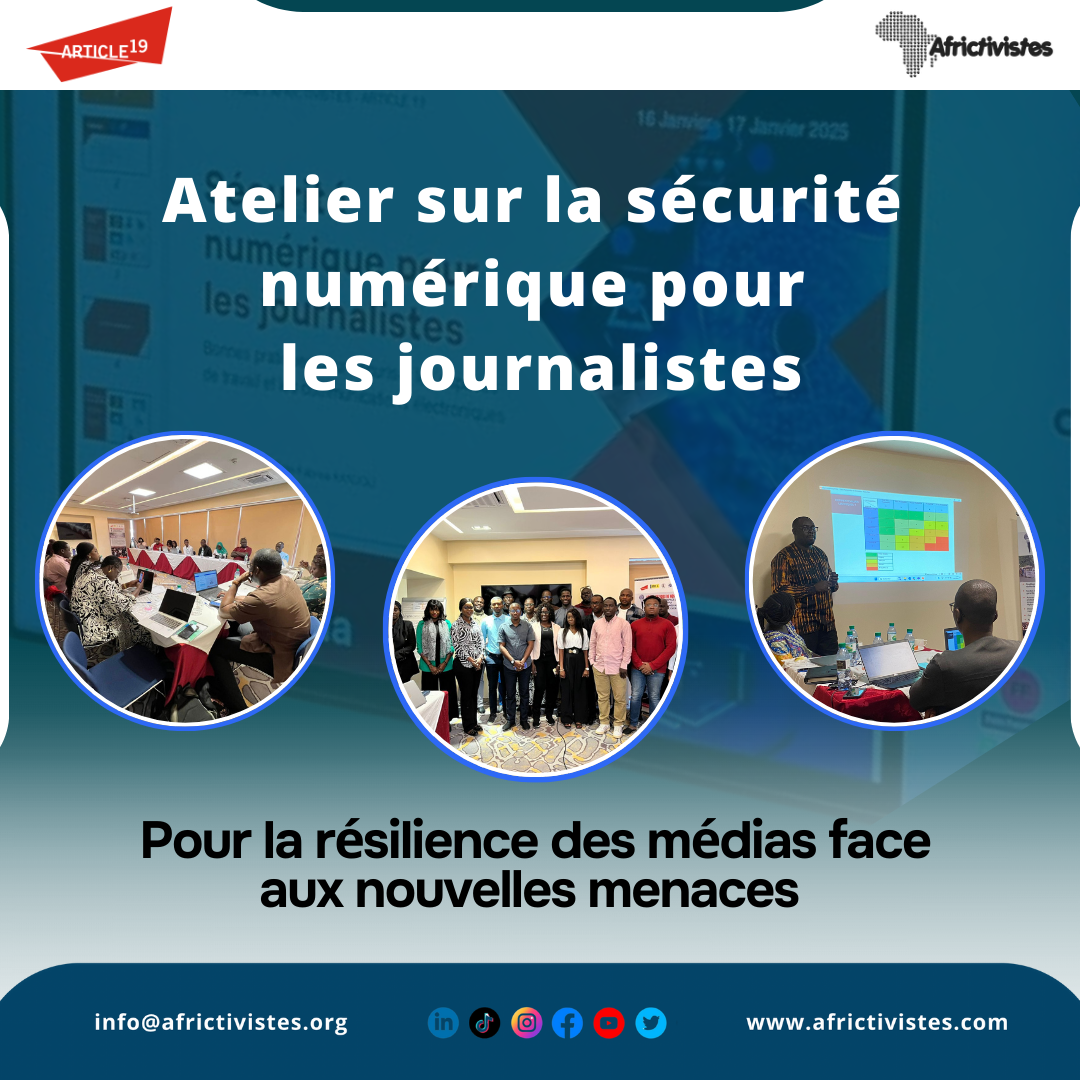
From 16 to 17 January, AfricTivistes in collaboration with Article 19, provided media professionals with the tools to tackle cyber threats and physical attacks. This workshop forms part of a wider project to document and protect civic space in Senegal. Over the course of two days, journalists and other media professionals took part in sessions ranging from raising awareness of the current digital threats faced by journalists to a comprehensive session on journalists’ physical safety and techniques for defence and risk prevention.
The finding stems from the fact that in many countries around the world, including Senegal in recent years, the shrinking of civic space and violations of fundamental rights – notably freedom of expression, freedom of the press and access to information – continue to pose major challenges. Published in June 2024, the report by Reporters Without Borders (RSF) on press freedom in Senegal documented, in the last three years alone, more than 30 cases of journalists being subjected to police violence, as well as 15 arrests and detentions of journalists…
Abdoulaye Ndiaye, Programme Officer at Article 19, opened the workshop with a session on the human rights situation in Senegal, focusing in particular on press freedom and the safety of journalists. He discussed at length the national and continental frameworks that protect journalists in the course of their work.
The second session on best practices for securing workspaces and electronic communications was led by Félin Fabrice Kalonji, an expert in digital security. During his presentation, he explored all kinds of digital threats, such as account hacking, phishing, identity theft, electronic surveillance…
The expert, who delivered his presentation via video link, also outlined best practices for dealing with online threats, to ensure safe internet use and, in the case of journalists and media professionals, to enable them to carry out their reporting duties safely.
At the same time, Mateuw Mbaye, Head of Protection and Civic Space at ARTICLE 19, and Abdoulaye Guene, IT Digital Support and Developer at AfricTiv, outlined the current digital threats facing journalists in order to raise participants’ awareness of the evolving and varied nature of the dangers they may encounter whilst carrying out their duty to provide the public with accurate and truthful information. The increased use of technological tools has given rise to new forms of threat. Illegal surveillance practices, made possible by technologies such as the Pegasus software.
The second day was devoted to physical security and the coverage of sensitive events, with Ngor Badu Dione, a member of AfricTivistes and an expert in risk management.
This issue was particularly significant in the Senegalese context. From 2021 to 2024, whilst reporting in the field or covering sensitive events, such as demonstrations, media professionals were often subjected to violence from various sources.
The risk management expert began by clarifying the concepts to enable the participants to gain a clear understanding of the subject. To illustrate these concepts effectively, examples were drawn from the participants’ own experiences.
Working in teams, the participants identified and analysed the risks inherent in covering events, making the session interactive and participatory. In his closing remarks, Mr Dionne provided the media professionals present with a list of practical tips on how to ensure their personal safety, protect themselves and respond to threats.
To conclude the training session, Abdou Aziz Cissé, Democracy and Governance Advocacy Officer at AfricTivistes, presented a study on the vulnerability of the media in Senegal in terms of digital and physical security. This marks a renewed commitment by AfricTivistes to ensuring that the media are resilient in the face of digital and security threats, and to fostering sustainable democracies.