Sahel and West Africa: seven recommendations to loosen the grip on civic space
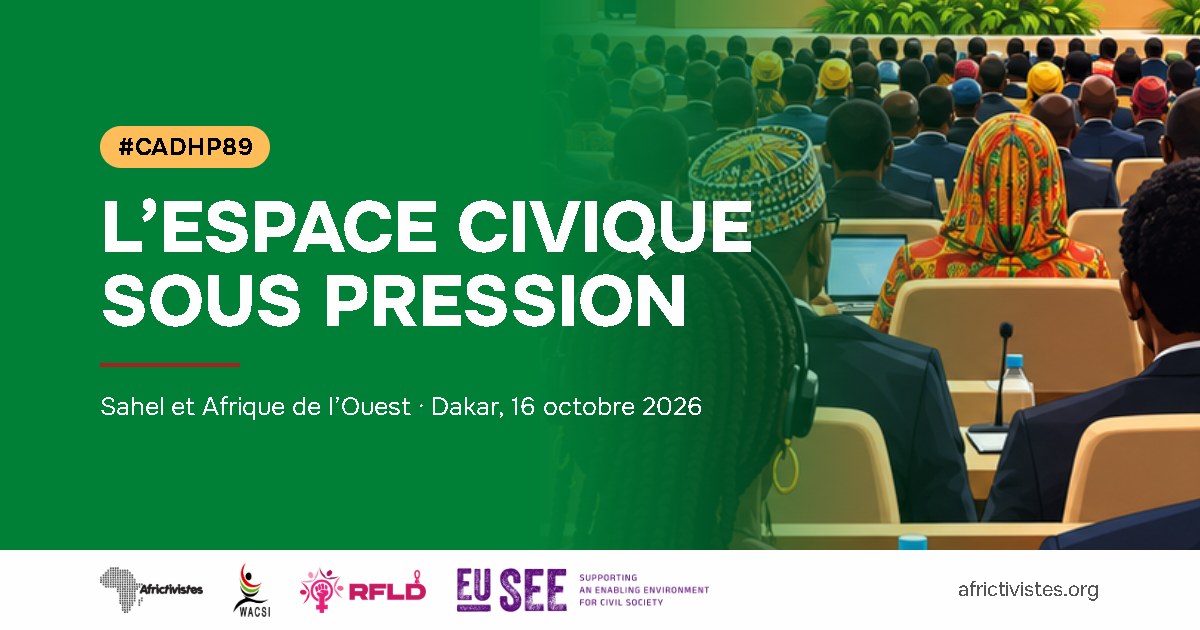
On the margins of the 89th Ordinary Session of the ACHPR, WACSI, RFLD and AfricTivistes co-organised the meeting “Civic Space Under Pressure: Freedom of Association and the Growing Judicialisation of Civic Action in the Sahel and West Africa” in Dakar on Friday 16 October, with the support of EU SEE. Human rights defenders, lawyers, journalists and civil society organisations examined the restrictions weighing on civic action, and how to respond to them.
Restrictions on every front
Omolara Balogun, Head of the Policy Influencing and Advocacy Unit at WACSI, set out the situation: “Across West Africa, civil society organisations and citizen movements face political, security and economic restrictions.” Dissolutions, repression, economic pressure, and the use of legal and constitutional means to restrict civic space: in her view, reprisals against human rights defenders are among the greatest threats today.
The aim of the meeting was not to catalogue violations, she explained, but to strengthen engagement, explore avenues for protection and identify practical steps for coordinated advocacy before the African Commission, starting with better documentation.
In his opening remarks, Cheikh Fall, President of AfricTivistes, framed his address around three “bubbles”: the citizen and institutional bubble, the generational bubble, and the bubble of skills and knowledge. He questioned institutions that reflect our social and political relations, how Generation Z can reinvent engagement alongside earlier generations, and what experts can offer communities and families. His call: build bridges between citizens, institutions, generations and knowledge holders.
When the process becomes a weapon
Bezahinibe M. Somda of Lawyers Without Borders Canada described the effects of judicialisation on those who bear it: “Judicial proceedings can be used as a means of intimidation against human rights defenders. This pressure can lead to self-censorship, limit their freedom to act and have other harmful consequences for their work to protect and promote human rights.”
For Papa Ismaïla Dieng of AfricTivistes, this pressure crosses borders: “Judicial proceedings are a permanent threat to civil society organisations. This pressure can also reach their partners and supporters abroad, who often have to self-censor to protect the physical safety of activists on the ground.”
Another participant raised the alarm over the deterioration of civil liberties in Guinea, marked by growing restrictions on civic space. He pointed in particular to the dissolution of more than 100 political parties, more than 60 people killed during protests, nearly forty enforced disappearances, and the exile of many activists and human rights defenders.
He also recalled the discovery last August of six bodies in a mass grave in the prefecture of Forécariah, following a similar case in October 2025 in the same locality. AfricTivistes and other human rights organisations had then issued a joint statement calling for independent and transparent investigations to shed full light on the case and establish responsibility.
Broadening his analysis to the countries of the Alliance of Sahel States (AES), he denounced political interference in the judiciary. In his view, this is restricting fundamental freedoms and gradually shrinking the space available to citizens and civil society organisations to speak out, mobilise and carry out their activities democratically.
These findings echo the joint statement delivered by WACSI and AfricTivistes before the Commission at the start of the session, which raised the alarm over the judicialisation of civic space in West Africa.
Document, engage, implement
In the face of these pressures, documentation emerged as a common thread. “It is impossible to build strong legal advocacy without documentation,” Bezahinibe M. Somda stressed. “Our legitimacy rests on our ability to prove human rights violations and to rely on evidence to hold States to their legal obligations.” She also noted that defenders often need psychological support, and that documentation should help build action, not only serve as evidence.
A participant from the Sahel pointed to the limits of civil society: no one can force a State to act. Hence the need to engage with the authorities, not only to denounce but also to remind them of their obligations, to keep bringing violations before the Commission, and to make every citizen the driver of their own change through legal empowerment.
Omolara Balogun stressed that there are enough protection instruments: the main challenge is implementing them, hence the importance of advocacy for their effective application and of regional solidarity. Paul Osei-Kuffour, Coordinator of the WADEMOS network, called for tackling root causes, not only symptoms, and for building a solidarity that leaves no country in the region isolated.
Owning African mechanisms
Ibrahima Kane, lawyer and human rights defender, reflected on the contribution of African civil society organisations to the work of the ACHPR. States set up mechanisms without involving civil society; it is now up to civil society to use them, and to use them well. “If the African Commission is what it is today, it is thanks to civil society.”
Papa Ismaïla Dieng pointed to the limits of these institutions, which States design so that they cannot turn against them, citing in particular the limits of the ECOWAS Court of Justice.
For Gilles Yabi of WATHI Think Tank, the challenge is also to reach as many people as possible: “To reinvent African civil society, we must mobilise and convince the majority of our populations, especially young people.” He called for going out to meet them, creating spaces for dialogue and raising awareness of regional and continental frameworks, from the African Union to ECOWAS.
Fatoumata Sy of the Senegalese Network for Human Rights Education called for rights that everyone can understand: “We must join forces to promote human rights and strengthen efforts to protect them. It is essential to make them accessible in our local languages so that every citizen can understand them and make them their own.”
Recommendations for the Commission
The discussions led to several recommendations:
- make it easier for civil society organisations to obtain observer status with the Commission;
- institutionalise protection mechanisms for defenders;
- improve access to remedies, as many mechanisms remain little known;
- strengthen the follow-up of recommendations and decisions;
- protect victims, their families and their sources;
- make judicial independence a regional priority and prevent political pressure;
- investigate reprisals.
This meeting concludes the series of three activities AfricTivistes co-organised on the margins of the session, presented in our launch article. Its conclusions will feed into the advocacy of AfricTivistes and its partners before the Commission. AfricTivistes’ pan-African citizen consultation remains open for contributions.