Joint statement by WACSI and AfricTivistes: “The law should protect those who defend rights, not become another instrument for silencing them”
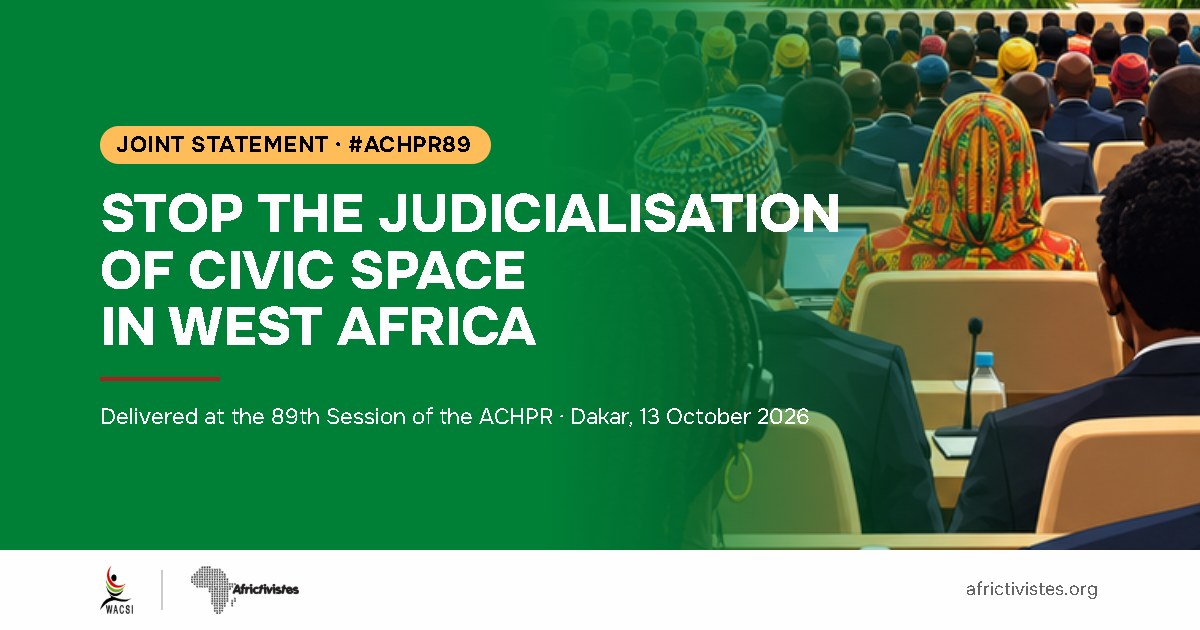
During the plenary session of the 89th Ordinary Session of the African Commission on Human and Peoples’ Rights (ACHPR), held in Dakar on Tuesday 13 October, the West Africa Civil Society Institute (WACSI) delivered a joint statement on behalf of WACSI and AfricTivistes. Its purpose: to raise the alarm over the growing judicialisation of civic space in West Africa, and to call on both States and the Commission to act.
When the process becomes the punishment
The statement welcomes Resolution 667, adopted at the 88th Session, which calls for an Africa-wide study on strategic lawsuits against public participation (SLAPPs): legal actions brought to silence those who take part in public debate.
It describes a trend that is spreading across the region. Broadly worded laws on defamation, cybercrime, false information and national security are increasingly used to restrict legitimate expression and peaceful organising. For WACSI and AfricTivistes, the issue is not only whether people are convicted: “The legal process itself is a punishment.” Prolonged proceedings, legal costs and threats of imprisonment wear down defenders and their organisations. They discourage participation and drive some to give up their work altogether.
A regional emergency
The statement points to several recent developments:
- in April 2026, Burkina Faso announced the dissolution of 118 civil society organisations, including human rights groups;
- in Guinea, an appeals court upheld the conviction of an opposition figure;
- in Niger, restrictions have been placed on political parties and online expression;
- in Togo, there have been protest-related arrests and disruptions to digital access;
- in Nigeria, there have been cybercrime prosecutions and a 100 million naira civil claim against the organisation SERAP.
Across the Sahel, defenders and journalists also face surveillance, threats, enforced disappearance and pressure on their families. Women defenders face additional risks, such as sexualised online abuse and attacks on their reputations, which can push them out of public debate.
While acknowledging States’ responsibility to address terrorism and violent extremism, the statement stresses that national security can justify neither arbitrary detention, torture, enforced disappearance nor the criminalisation of peaceful dissent.
Five steps for States, one call to the Commission
WACSI and AfricTivistes urge States to:
- reform laws that criminalise expression, association and peaceful assembly;
- end arbitrary detention and enforced disappearance, and investigate allegations of torture;
- guarantee judicial independence and the right to a fair trial, with safeguards against abusive litigation;
- prevent the arbitrary suspension or dissolution of civil society organisations, through transparent decisions subject to independent review;
- strengthen protection for defenders through legal aid, safe reporting channels, and responses to digital attacks and cross-border reprisals, with particular attention to women defenders.
They also call on the Commission to implement Resolution 667 through a consultative study that examines not only SLAPP cases but also their effects: legal costs, self-censorship and defenders withdrawing from public life.
“Civic space is not a privilege”
The statement closes on a principle: “Civic space is not a privilege granted by governments. It is protected by the African Charter and is essential to accountability, public participation and the realisation of human rights.”
This theme will be at the heart of the event co-organised by WACSI, RFLD and AfricTivistes on Friday 16 October: “Civic Space Under Pressure: Freedom of Association and the Growing Judicialisation of Civic Action in the Sahel and West Africa”.