After Chad and Senegal, AfricTivistes trainers arrive in Burkina Faso

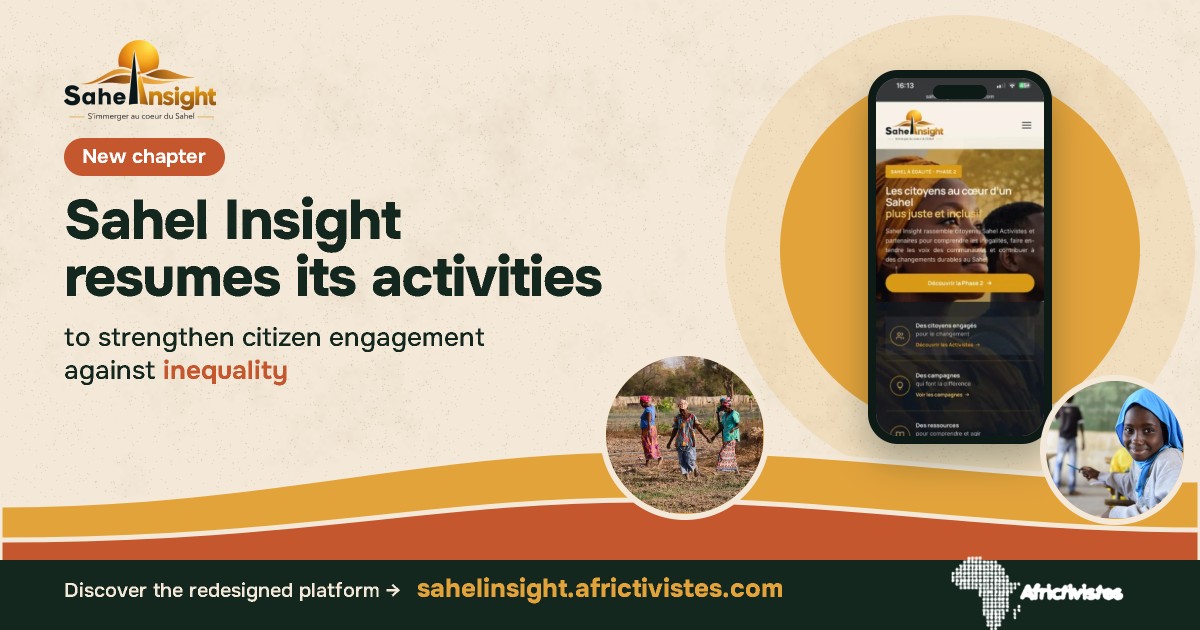
After Chad and Senegal, AfricTivistes trainers have arrived in Burkina Faso to support and equip a collective of change-makers as part of the Sahel Insight project. This series of training sessions uses a new co-creation and collective intelligence methodology, with sessions on civic engagement, civic leadership, digital campaigning and influence, and integrating gender policy to support civic participation in reducing inequality in the Sahel.
Against a particular backdrop of a series of coups d’état in West Africa, the challenges of sustainable and inclusive reconstruction are considerable. In this geopolitical and security climate, these young people say they are aware of their commitment, both individually and collectively. They believe that between 1984 and 2021 they have had greater impact and a greater capacity to influence, and they plan to join forces through community action to address the countless problems caused by inequality. In their view, these include extreme poverty, violence, corruption, ethnic divisions, regionalism, illiteracy, a lack of civic-mindedness and injustice.
Meeting in Burkina Faso’s capital from 21 to 24 February 2022, this group of around 20 participants committed to joining forces to become a strong collective resource and genuine change-makers with the power to transform society. Although many of them had been active individually, the training gave them a chance to get to know one another.
In his opening remarks, Mr Omer Kaboré, Oxfam’s Country Director in Burkina Faso, welcomed the AfricTivistes team and reassured them “that they were at home, despite everything we are going through in the country”. He also spoke about the importance of this project, led by AfricTivistes in partnership with Oxfam and WiLDAF: “This training,” he said, “is an opportunity for young people in Burkina Faso to become familiar with the concepts and issues surrounding civic engagement, and to gain skills in digital campaigning so they can better understand the challenges involved in tackling inequality in the Sahel.”
As in N’Djamena and Dakar, the Sahel Activists who took part in the Ouagadougou session drew on the Burkinabè context to define inequality as an unequal distribution of wealth. This is reflected in the majority of the population being unable to access basic social services, as well as in injustice compounded by certain socio-cultural, religious and political practices and beliefs.
The young activists in Burkina Faso plan to focus on actions that, over the long term, could help change attitudes and behaviour by raising awareness of inequality, so that the whole country can take ownership of the struggle.
In their view, this struggle can only succeed if it involves:
- Respect for human rights
- Promoting education
- Access to basic social services
- Women’s political participation
- Coordinated action
- Equal justice
- An inclusive approach to developing and implementing public policy
- Quality education for all
Through a SWOT analysis, the young people identified their strengths as a collective. They are counting on their determination and resilience, their diverse skills and cultures, their capacity for innovation and team spirit, their shared motivation and passion, and their individual and collective networks.
Their group work helped them identify three main ways to contribute to the fight against inequality in Burkina Faso:
- Designing and launching a web platform on inequality in Burkina Faso
- A training programme on civic engagement and inequality
- An awareness-raising campaign on inequality
These actions could have a significant positive impact on the fight against inequality in Burkina Faso—a struggle that will certainly not be won in a day.
They are convinced that the internet is currently the best way to train, educate and engage the community. Alongside creating a dedicated web platform, they will train and equip 180 students in civic engagement and reducing inequality through nine training sessions, and launch a campaign on child marriage.
The Sahel Activists in Burkina Faso understand the sensitive nature of their work and are aware of the threats they face, as well as their weaknesses as a collective of change-makers. Developing and analysing a stakeholder and power map helped them identify the actors opposed to change in the Burkinabè context.
At the end of this training on civic engagement, leadership, gender and digital campaigning to tackle inequality, participants shared their impressions in interviews.
Bailou Bénédicte, a legal expert specialising in women’s rights and coordinator of the Femin-in association, which promotes women’s civic participation in Burkina Faso, said the training was practical, intensive and technical. “Practical because of the collective intelligence methodology used by AfricTivistes. Intensive because we had to stay focused throughout the sessions given the importance of the material. Technical because we were equipped to achieve the expected results,” she explained.
Asked whether the training would be useful for his personal and community projects, SON Aboubacar, a sociologist and Chair of the Board of Leadership Jeune Pour La Paix et Le Développement en Afrique, replied that he had already begun applying this methodology with a group of young people through his association.
SANA Amdiatou, communications officer at the Association for the Well-being of People in Need (ABPN), said that her understanding of gender had evolved considerably. Thanks to the training, she now understood the issues involved in tackling gender-based violence.
It should also be noted that Oxfam’s country office has committed to meeting with the collective to explore ways of working together and implementing Sahel Activists Burkina Faso projects.
The AfricTivistes trainers will next be in Niger from 7 to 11 March 2021, the final stop on the roadshow for the first phase of the AfricTivistes Sahel Insight project.