Civic Tech Solutions !

“Citizen Participation and Civic Tech: Current Situation and Challenges in Africa” was the theme of the second session of the “Fridays with the MOOC on Democracy, Elections and Governance in Africa”, organised on 12 August 2022 by AfricTivistes. This webinar was hosted by Nompumelelo Runji of the Democracy Works Foundation and Fodé Sanikayi Kouyaté, an executive member of AfricTivistes and coordinator of mayors within the Open Governance through Digital Technology project run by AfricTivistes, Local Open GovLab (LOG). The panel was moderated by Mr Maurice Thantan, Project Officer at AfricTivistes.
The podcast is below
A relatively new concept, civic technology (Civic Tech) encompasses both the technologies and approaches that promote and strengthen the role played by citizens in public debates and decision-making within the framework of the democratic functioning of societies and communities.
In Africa, the rise of Civic Tech has coincided with several major turning points: the democratisation of internet access, the growth of social media and the proliferation of training programmes in the digital technology sector.
Over the past decade or so, the emergence of technology in the public sphere – and more specifically in democratic debate – has consistently produced striking results. From the online campaign #Sunu2012 in Senegal to the MonElu app in Mali, Civic Tech initiatives can take many forms depending on the context in which they emerge. Dozens of Civic Tech initiatives have sprung up across Africa, with varying degrees of success.
However, on the African continent, the call for democratisation expressed by young people is met with significant challenges. It is therefore legitimate to ask whether Civic Tech can provide clear answers to the various issues at hand. Such an approach would only make sense if the subject were to be given thorough consideration.
It is with this in mind that this webinar forms part of the MOOC “Democracy, Elections and Governance in Africa”, an initiative of the Charter Project Africa.
Below is a summary of the various panellists’ contributions.
Nompumelelo Runji, Democracy Works Foundation
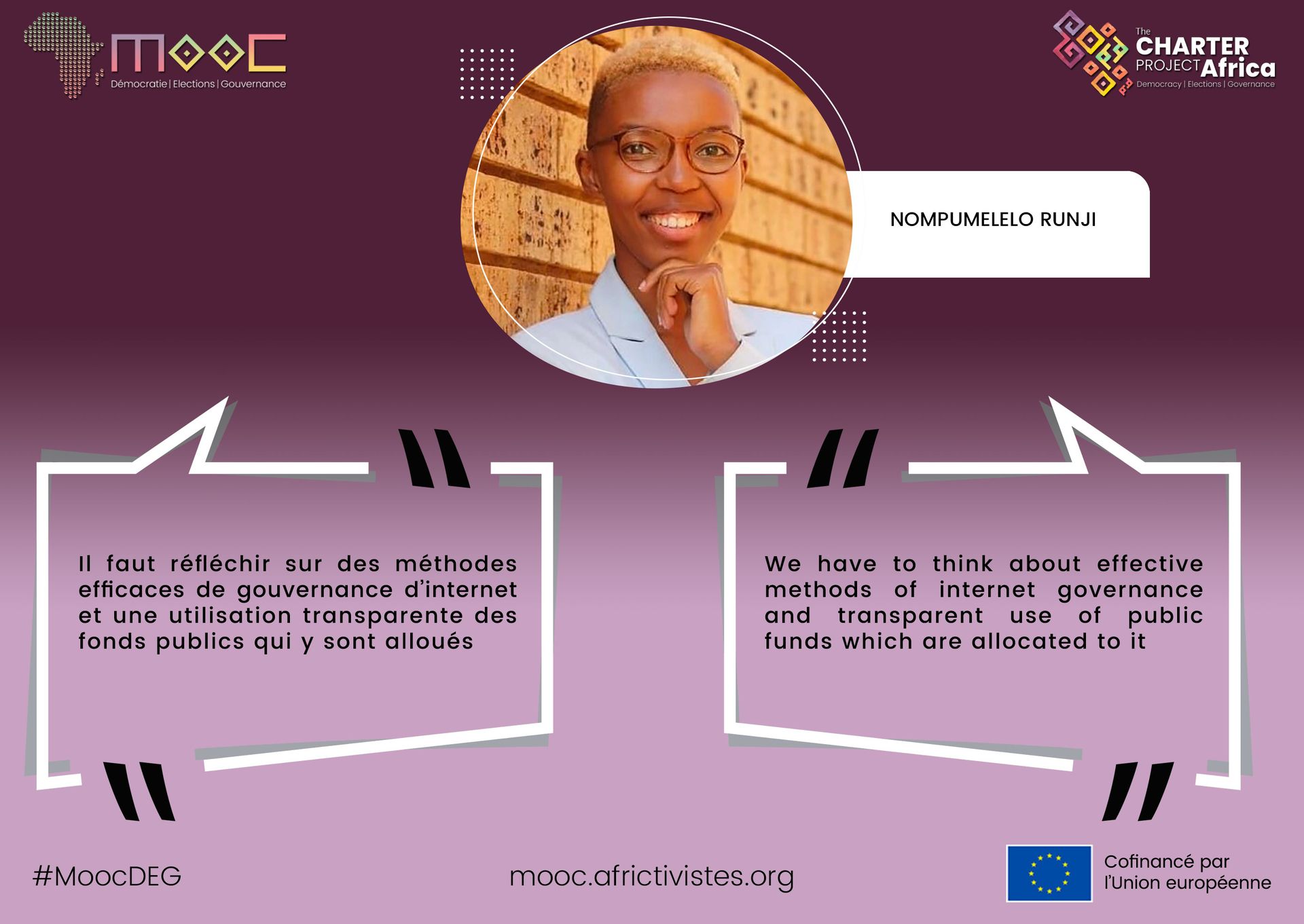
“Those responsible for implementing public policies must work to improve access”
“We must work to bring citizens closer to decision-making bodies. There must be mechanisms within the various state institutions that enable citizens’ views to be gathered. In any case, citizens are always called upon to express and convey their views.
Therefore, for a democracy to function, citizens must be involved in decisions aimed at improving their living conditions. But they must also be involved in all decisions relating to democratic procedures and the choices expressed during an electoral process.
Today, when we look at the democratic landscape in Africa, we realise that there is a strong commitment on the part of African civil society. People are organising themselves into pressure groups and seeking to bring about certain democratic changes and changes in other aspects of political, economic and social life.
And when we talk about Civic Tech, we are talking about enabling citizens to get very actively involved and have a significant impact in driving change as civic actors. (…)
Across the continent, there is still a divide between rural and urban areas. When we look, for example, at ICT penetration rates or the way in which technologies – or even just basic mobile phones – are developed, various applications and technologies are being created to enable people to have equal access to decision-making bodies or even local governments. (…)
We need to consider how those living in the most remote areas can gain access to these technologies. Those responsible for implementing public policy must work to improve access.
I think civic tech could play a role in amplifying citizens’ voices through mobile technologies. (…)
We need to consider how Civic Tech can be used to ensure responsible internet governance and to guarantee that public funds are used transparently and are not misappropriated. Indeed, when citizens are dissatisfied with the performance of certain civil servants, they must be able to report this via technological mechanisms that enable their supervisory authority to take appropriate action.”
Mr Fodé Kouyaté, member of the AfricTivistes Core Team
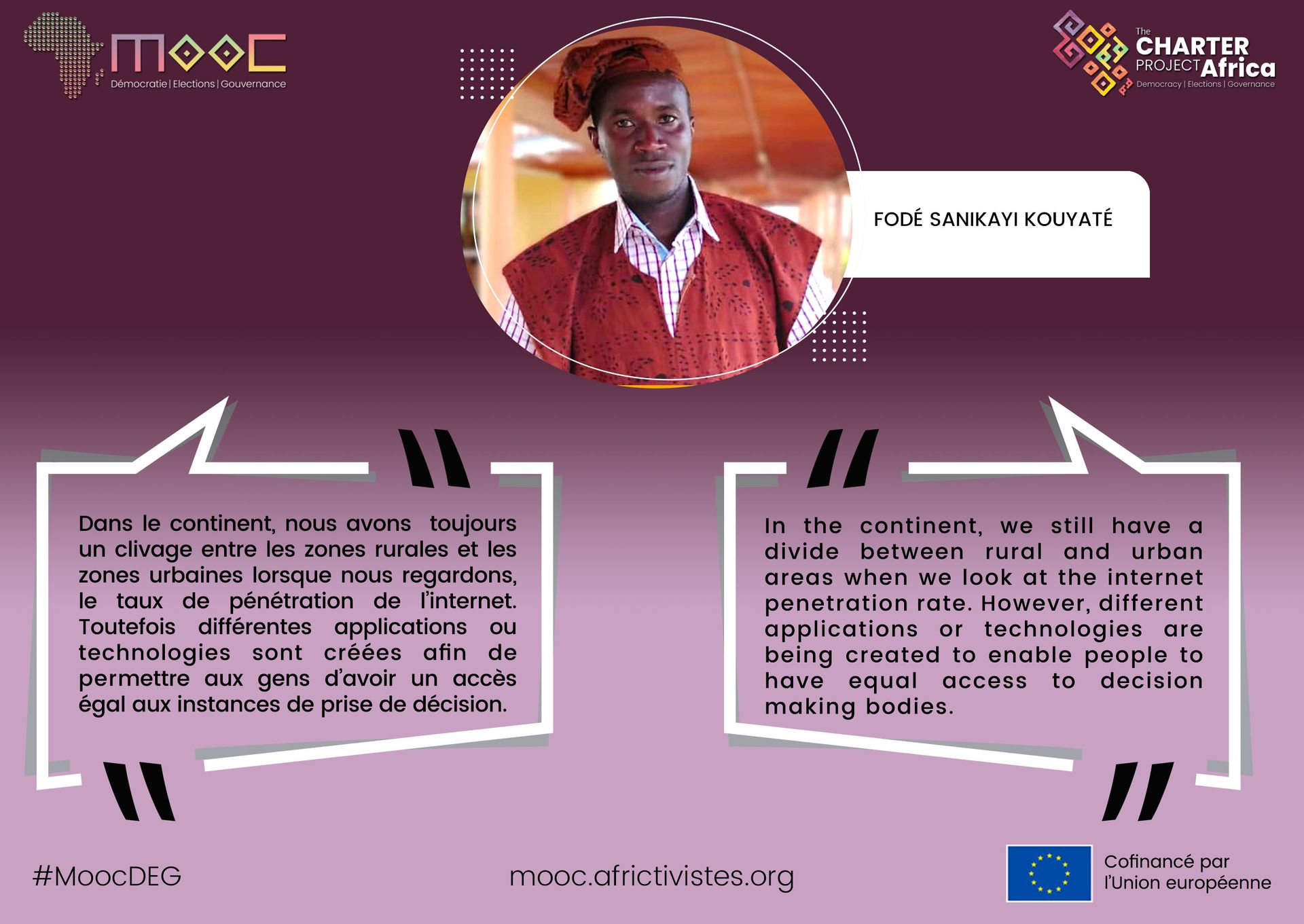
“Few players in the civic tech sector have the ability to make data speak”
“The term ‘Civic Tech’ refers to all the methods, tools and processes that are put in place to influence decision-making, whether through proposals or critical actions, by using information and communication technologies. It also encompasses any use of technology to improve political or economic governance in our various countries.”
Nowadays, when we talk about Civic Tech, we tend to refer more to the political aspect than to the economic one. This is a real shame, as we also need to focus on the other aspects in order to improve technology-driven governance
I think there has already been significant progress in terms of access to information, which has become vital. Especially as the internet is not limited solely to the telephone network – that is, calls and text messages. The internet has become central to all aspects of access to information. We can therefore gauge the level of access to information via the internet.
Unfortunately, there is a gap between large and small towns when it comes to access to information. Not to mention the issue of the quality of information, which is a concern in most of our countries, and the type of content used.
This is where the issue of data comes in. Do we currently have enough data that can genuinely convey the kind of information citizens are looking for? Do these channels allow us to share everything amongst ourselves? Is it actually available? We should be asking all these questions whilst recognising that progress has been made in terms of access to information on a certain scale.
It is true that there has been a marked improvement in the flow of information in terms of quality and the data we need on a particular topic. However, one wonders whether all this data is presented in usable formats. One might also question whether the people handling this data have the necessary qualifications.
“Today, when you look at the organisations involved in civic tech that are working on governance issues or focusing on data, few of them have the capacity to make sense of that data. So the issue of capacity-building is key. And not just on the political front.”
It should be noted, in conclusion, that around thirty participants attended the event, which was highly interactive and further demonstrates that the issue of civic tech is of interest to many young Africans and civil society actors.
Mr Tidiani TOGOLA, Executive Director of the Tuwindi Foundation, was due to be one of the panellists. Unfortunately, he was unable to attend at the last minute.
See you soon for another webinar on a different topic covered as part of the MOOC on Democracy, Elections and Governance in Africa.