“How can we revitalise the flagging open government movement in French-speaking Africa?”
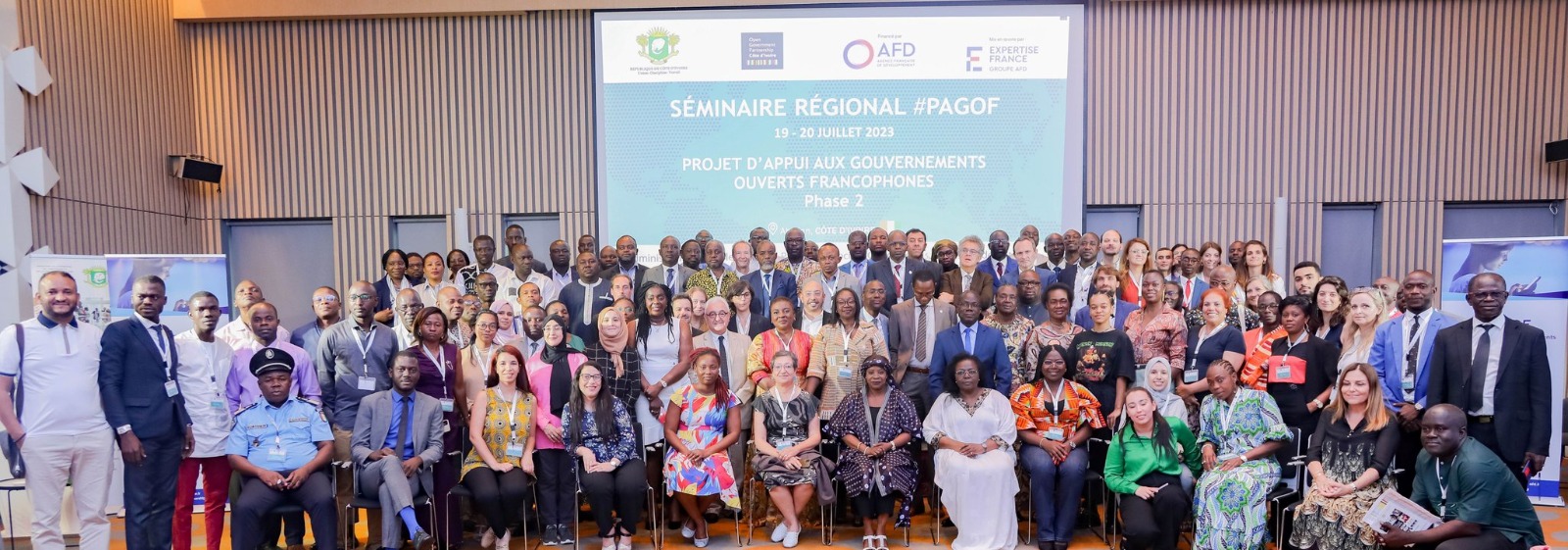
This question, which serves as the title of this blog post, came up time and again during the sessions (round-table discussions, workshops, informal discussions) at the PAGOF forum, which brought together nearly 200 reformers from government and civil society across 18 French-speaking African countries in Abidjan (Côte d’Ivoire) on 19 and 20 July 2023. Having taken part in most of these sessions and spoken with the various stakeholders, a few optimistic avenues are emerging amidst the questions tinged with pessimism. I have picked out a few that strike me as both original and promising in terms of revitalising the open government movement in French-speaking Africa.
1- What sort of shortness of breath are we talking about?
But before going into detail, I believe it is essential to define the stagnation in question. In this regard, it is worth recalling that the Open Government Partnership was launched in 2011. By setting itself the task of promoting the concept of ‘open government’, this multilateral partnership set itself the objectives of promoting transparency in public action, notably through the opening up of public data; improving citizen participation in the development and evaluation of public policies; promoting integrity in public action and amongst public officials; and utilising new technologies to foster accountability.
Long confined to English-speaking countries, the movement is set to expand further into other countries. The open government initiative, which is already underway in the English-speaking parts of the African continent, will gradually gain traction in French-speaking countries. Tunisia, one of the
One of the first French-speaking African countries to join the PGO, it became a member of the partnership in 2014. Côte d’Ivoire followed suit in 2015. Burkina Faso joined them during the PGO World Summit in Paris in December 2016.
Following this event, France undertook, as part of its national action plan, to support French-speaking countries that so wished in their efforts to join the Open Government Partnership. It was this commitment, amongst other factors, that led to the creation of PAGOF. Morocco and Senegal were the last two French-speaking African countries to join the Open Government Partnership in 2018. The PGO summit in Paris gave new impetus to the open government movement in French-speaking Africa, with a mobilised civil society and the launch of PAGOF. However, five years after Senegal and Morocco joined, despite the progress made, no new members have been recorded. I emphasise the importance of these accessions because each one signifies that the country in question has met the eligibility criteria, has committed to working with civil society, and has made concrete commitments, the implementation of which is assessed at regular intervals. This is a very important point that deserves to be mentioned.
Worse still, in recent years there have been signs that the initial momentum is slowing down. Sometimes this is for obvious reasons. For example, Guinea was one of the countries on the verge of qualifying for the PGO. With the military regime having been in power for the past two years, the process has stalled and civil society organisations lack points of contact. Niger, for its part, is now eligible, but the authorities have shown no intention of joining this community of best practice. The case of Benin is also worth mentioning. The country expressed its willingness to join the PGO in 2015. Although genuine efforts are being made in Benin to uphold the values promoted by the PGO, eight years later, it is still not eligible. Symbolising the doubts that fuel discouragement, particularly within civil society, in 2022 Benin narrowly missed out on eligibility due to bureaucratic hurdles.
To these examples, we can add the general trend towards restrictions on civic space across the continent, and in West Africa in particular, the terrorist threat and the setbacks to democracy, all of which act as obstacles to the long-term sustainability of an open dialogue on open government, which necessarily involves public authorities, local elected representatives and civil society actors.
2 – Three lessons learnt from the 2023 PAGOF seminar in Abidjan
Despite this challenging context, “there is room for hope”, as several people reiterated during the two-day PAGOF 2023 seminar in Abidjan. Indeed, this was one of the positive notes that characterised the seminar. To see this hope translate into significant progress, numerous avenues are being explored on both sides. Having listened to the various speakers and taken part in a range of debates and discussions, here are the three key takeaways from the seminar, which represent three clear paths towards revitalising the open government movement in French-speaking Africa.
● Revitalising the concept of ‘open government’
“Dusting off” seems to be a dirty word. But it is the term that came up frequently in discussions and suggestions, and which ultimately strikes me as appropriate to sum up the need to (re)clarify the concept. The distinctive feature of open government is that it invites public authorities and civil society to collaborate on an equal footing for the benefit of the people. In practice, several segments of the Abidjan seminar sessions illustrated this perfectly: the two stakeholders harbour conflicting views on the same subject. Most of the time, this is because each, depending on their position, develops a different conception of open data, access to information, budget transparency, and so on. Ultimately, whilst open government promotes dialogue, trust and collaboration, it is mistrust, reserve and exclusion that take hold. ‘Dépoussiérer’ therefore amounts to shedding light on the concept of open government in order to make it accessible to all and ensure a common level of understanding.
For civil society actors, who in most countries are at the forefront of this effort, it will also be a matter of renewing their approach to advocacy. As Tarik Nesh-Nash, head of the PGO for Africa and the Middle East, puts it, it is far more effective to ‘convince’ a policy-maker of the positive benefits that their country’s membership of the PGO would bring to them and their government than to argue on the basis of the obligations and constraints that would result from it.
Finally, it is also necessary to update the concept in order to gain a clear understanding of the region’s policy agenda. Whilst speaking with government representatives, I was told that membership of the PGO is not an end in itself. Whilst it is true that our countries are part of mechanisms designed to promote good governance, it must be recognised that the PGO is one of the few partnerships – if not the only one – that places civil society at the heart of the operational framework for its implementation at all levels.
● Focusing on local authorities
One of the most promising avenues for revitalising the open government movement in French-speaking Africa lies at the level of local authorities. Local government, by its very nature, is well-suited to experimenting with the key principles of open government. Several initiatives confirm that this avenue warrants further exploration. AfricTivistes, the network of African bloggers and web activists for democracy to which I belong, for example, launched a project in 2021 called Local OpenGov Lab. This project enabled open government to be trialled in around ten local authorities in the sub-region, most of which are in countries that are not members of the Open Government Partnership (OGP).
The conclusions are simple: whilst central governments struggle to take the plunge, the impetus can come from the local level. Local authorities have the advantage of being small in scale; elected representatives are sometimes highly motivated; and, above all, the public feels a sense of ownership and can see tangible results. It is generally accepted that when the public feels involved in the management of public affairs, trust is strengthened, as is civic-mindedness across the board. Morocco and Tunisia also have some excellent examples in this regard which can serve as inspiration for other countries.
● Involve the media more closely
In line with the first lesson mentioned, open government suffers from a form of elitism and would benefit from being made more widely known. To this end, the media appear to be a key ally for several reasons. The need to involve the media more stems from at least two considerations.
Firstly, media professionals are among those who stand to benefit from the implementation of the Open Government initiative in our country.
Indeed, most countries in the sub-region suffer from the absence of a freedom of information law that meets international standards, is tailored to open data and ensures transparency. In other words, open government directly affects the media (at least in part) and, as a power in their own right, the media can act as a catalyst for advocacy. It must be acknowledged that, at present, this aspect is often lacking in the strategies implemented in various countries.
Furthermore, by giving the issue greater coverage, the media can act as a genuine channel for civil society organisations, which cannot achieve all their objectives within a reasonable timeframe on their own.
To conclude, I have deliberately chosen to highlight these various points which, in my view, seem to stand out somewhat. Indeed, some of the levers that can be utilised to accelerate the implementation of open government in French-speaking Africa are obvious, well-known to all and even timeless: raising awareness and education, strengthening institutional capacity, adopting legislation that supports open government, and promoting collaboration and technological innovation, to name but a few.