Election Civic Tech Fund: from funding to action
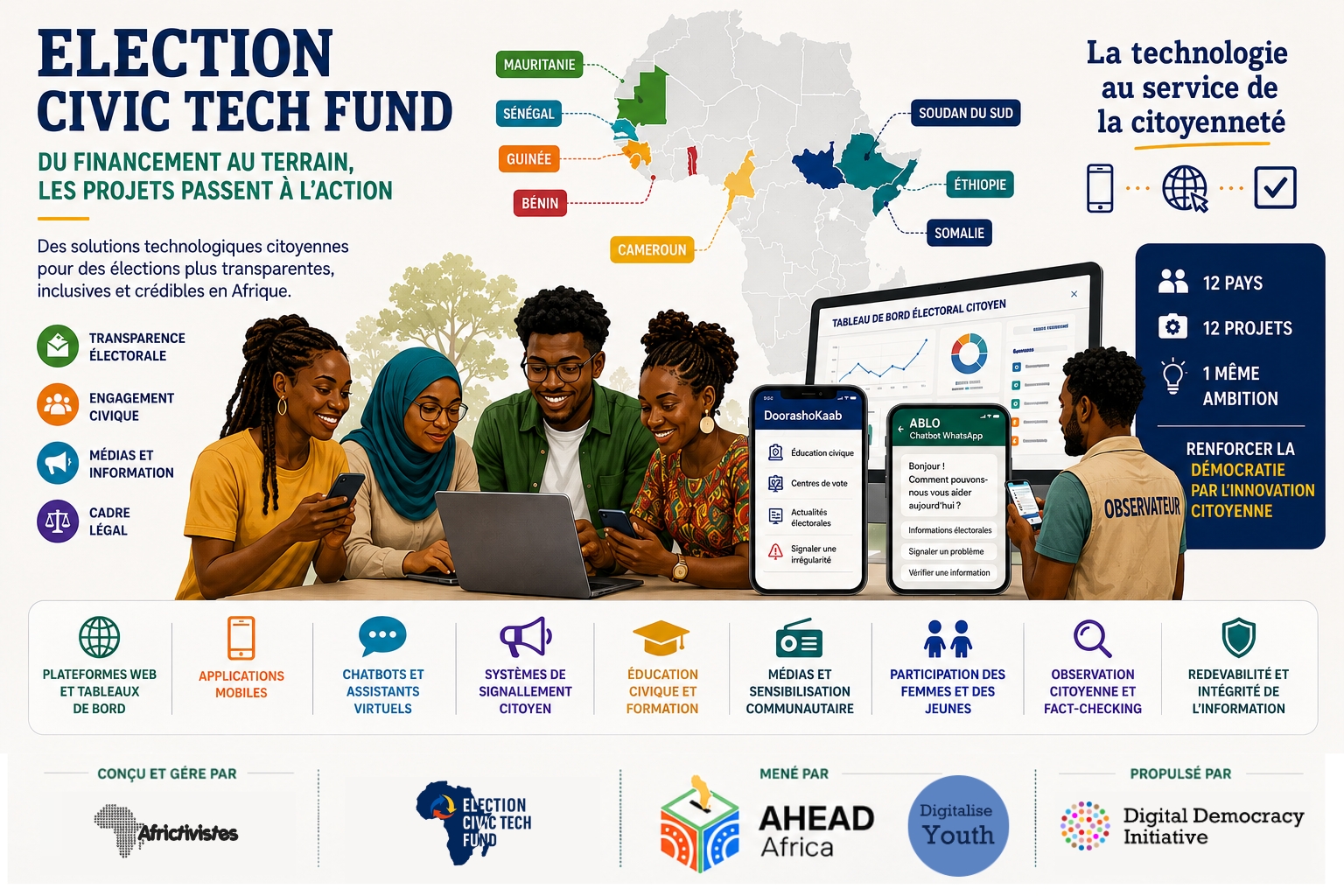
Following the announcement of the 12 winning projects in December 2025, the Election Civic Tech Fund entered its implementation phase. Since then, the 12 beneficiary organisations have been rolling out their projects on the ground.
The past few months have seen a surge in new launches: web platforms, mobile apps, chatbots and citizen reporting systems are emerging in the run-up to major elections, from South Sudan to Somalia, via Senegal, Benin and Ethiopia. Behind each tool lies the same ambition: to harness technology to ensure more transparent, inclusive and credible elections. Here is a country-by-country look at these developments.
In Benin, in the run-up to the presidential election, the Association of Benin Bloggers (AB-Bénin) has launched, with technical support from Vie Publique SN, a voter education platform enabling citizens to report irregularities and submit information for verification. AB-Bénin has also set up a citizen fact-checking unit (10 members) and run a digital awareness campaign in Lokossa (58 participants, including 22 women).
As part of its PACTE project, the Guinea Bloggers’ Association (ABLOGUI) has revamped its citizen observation platform #GuinéeVote (with nearly 1,500 users), launched a certified MOOC ‘Elections and Civic Engagement’ aimed at 100 young people, developed the ABLO WhatsApp chatbot and deployed more than 100 young e-observers in Conakry and across the seven administrative regions during the presidential election on 28 December 2025.
Vie Publique Sénégal has launched three initiatives: a citizen-led electoral dashboard, featuring data models for elections and an Open Data API currently being finalised; a Digital Observatory on Decentralisation, underpinned by a partnership agreement with the Local Development Agency in Senegal and datasets on municipal budgets and projects; and software for the automated reading of election results’ sheets using OCR.
For its part, the Wa Mbedmi Association has launched its Toopko platform, designed to monitor the implementation of the commitments made during the 2024 presidential campaign: the project began with a modelling workshop (9 participants) and the launch of a call for tenders to select a service provider for the development of the web platform.
In Cameroon, Brain Builders Youth Development Initiative (BBYD) has developed and optimised the beta version of its tool MyAIFactChecker: During the Cameroonian presidential election period in October 2025, more than 1,200 unique users assessed the reliability of information in several languages. Meanwhile, Actions for Development and Empowerment (ADE) upgraded its VoteCam app by incorporating new features: locating the nearest polling stations (opening hours, waiting times, accessibility), real-time election updates, notifications on key deadlines and centralised access to all election information, all designed to promote civic and electoral engagement.
The Mauritanian Association for Development, Research and Monitoring (ADRES) has developed a legal chatbot tailored to the Mauritanian context — conversational architecture, structuring of legal responses, a testing phase and the provision of limited access to users — in order to provide reliable and accessible legal information on electoral rights and participation.
In South Sudan, Excellence Foundation for South Sudan (EFSS) has launched The ClarityDesk, its platform dedicated to the integrity of electoral information (website and mobile app). The project also includes a fellowship programme for ten young journalists specialising in electoral fact-checking, as well as training sessions for 100 journalism students at university and secondary school level, and fortnightly radio programmes reaching 570,000 listeners.
For the June 2026 elections, the Ethiopian Women’s Federation launched a digital platform and a Telegram tool to boost the participation of women and young people in the electoral process. On the ground, a 5 km marathon involving 650 women and a wide-ranging awareness-raising campaign reached nearly 2 million people, whilst programmes broadcast on 11 radio stations across the country reached around 7.3 million listeners.
At the same time, the Consortium for Networking and Development (COND) officially launched its project aimed at civil society organisations (CSOs) led by young people and women, reaching 40 direct beneficiaries (20 young people and 20 women) and generating more than 20,000 interactions through its campaigns, with the aim of delivering training, inclusive digital campaigns and election observation activities in the run-up to the 2026 elections. The project was presented at an event attended by 45 representatives from CSOs led by young people, women and people with disabilities, as well as from public institutions and the National Election Board of Ethiopia. This meeting laid the foundations for enhanced coordination on inclusive voter education.
In Somalia, Bareedo Platform has launched its platform, DoorashoKaab, a civic tech solution available in Somali, Arabic and English, developed following a consultation workshop involving 80 young people from four regions and drawing on online civic education content. For its part, the Hopeline Foundation has developed a mobile civic education toolkit enabling simplified and accessible electoral information to be disseminated via text message. Thanks to this initiative, more than 1,000 citizens have been made aware of electoral issues through civic education activities and targeted SMS campaigns. The organisation has also trained 15 young community leaders as part of its ‘Civic Champions’ programme.
This operational phase of the Fund is already helping to translate technological innovation into tangible changes, by improving access to reliable electoral information, fostering inclusive citizen participation and enhancing the accountability of public bodies, thereby contributing to more transparent, inclusive and credible electoral processes across the continent.
It could be recalled thatthe Fund for Innovation in Citizen Participation in Electoral Processes in Africa (Election Civic Tech Fund), designed and managed by AfricTivistes, has a budget of 200,000 euros and supports citizen-led initiatives that use technology to improve electoral transparency, increase the participation of young people and women and promote democratic innovation. It is part of the AHEAD Africa project, co-funded by the European Union. It is driven by The Digital Democracy Initiative as part of the Digitalise Youth project.
For further information, please contact: info@africtivistes.org