Digital rights, women journalists, civic space: a day on every front at the ACHPR
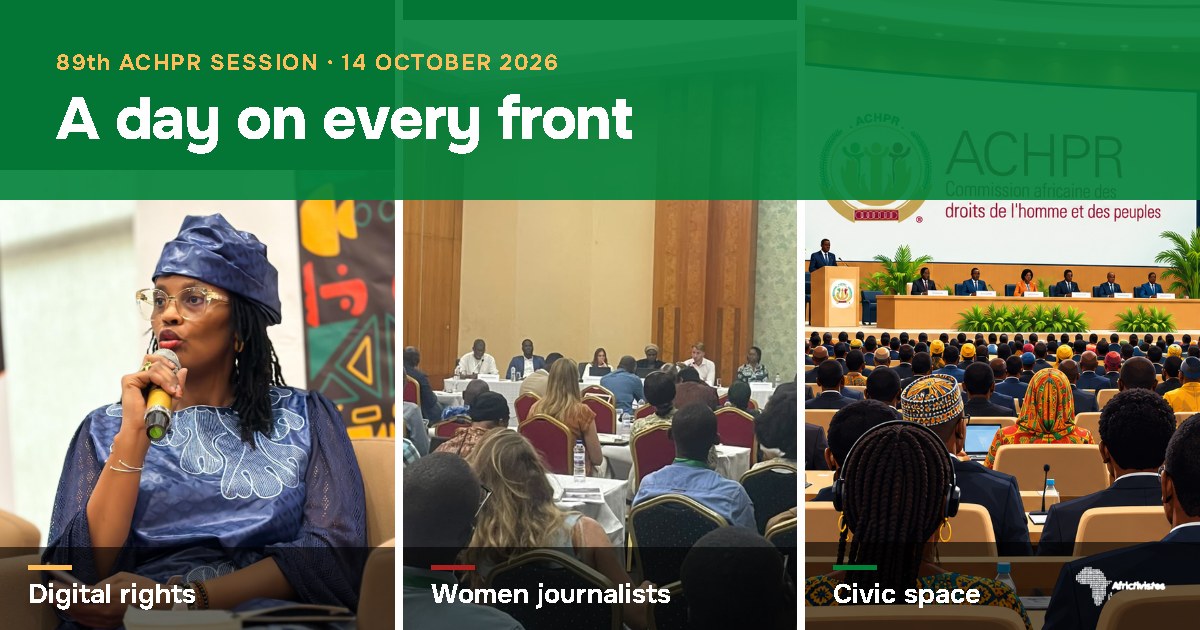
On the third day of the 89th Ordinary Session of the ACHPR, AfricTivistes carried its communities’ voices into several meetings in Dakar: a panel on emerging technologies and human rights, the launch of a report on violence against women journalists and defenders, and discussions on the situation of journalists in the Sahel. The day before, in plenary, a joint statement by WACSI and AfricTivistes raised the alarm over the judicialisation of civic space in West Africa.
Digital rights: an issue in their own right
Organised by AfricanDefenders and DefendDefenders, the panel “Emerging Technologies and Human Rights in Africa” addressed digital rights, artificial intelligence, digital surveillance and the protection of fundamental freedoms. Opening the discussion, Joseph Bikanda of AfricanDefenders set out the premise: “It is impossible for us to live without technology.” Hence the need to regulate its uses to prevent risks to human rights.
Speaking on behalf of AfricTivistes, Aisha Dabo argued that digital rights should no longer be treated as a side issue: “Digital rights should never be just an item or a paragraph in human rights reports. They must be considered as such and treated as an issue in their own right.”
She made a concrete recommendation: that the Commission set up a permanent framework to monitor digital rights, producing a periodic report on their state in member States. She also stressed that regulation cannot be purely repressive: “We also need safeguards that protect digital users and all citizens online.” And because “everything moves very fast online”, regulation and protection must keep pace.
Ibrahima Kane, lawyer and human rights defender, insisted on one principle: “Data collection must always comply with the law.”
Protecting women journalists and human rights defenders
In the morning, AfricTivistes took part in the launch of the report on gender-based violence against women journalists and women human rights defenders in Benin and Senegal. Organised by Lawyers Without Borders Canada as part of the RÉCIT project, the workshop presented the report’s main findings and recommendations. Prevention, protection and access to justice were at the heart of the discussions, for a safer environment in which women journalists and defenders can exercise their rights and freedoms.
Sahel journalists: witnesses reduced to silence
The situation of journalists in the Sahel also marked the day. A Burkinabè journalist forced into exile testified: “When a collective memory fades, an entire population is deprived of its right to information. When journalists are forced into exile, it is not only voices that move away, but also essential witnesses to our history that fall silent.”
A Malian journalist, also in exile, described the online harassment he faces: “With the rise of social media, death threats and intimidation have become our daily lives. I am hunted every day. Every morning, I wake up to find my photos circulating on social media, often accompanied by threats and attempts at intimidation.” For him, the stakes go beyond his own case: “it is press freedom, the safety of journalists and the right to inform that are under threat.”
These concerns echo those of AfricTivistes’ pan-African citizen consultation, still open for contributions. They will be at the heart of the next two meetings co-organised by AfricTivistes: the protection of young women in social movements, this Thursday 15 October, and civic space under pressure in the Sahel and West Africa, on Friday 16 October.