89th ACHPR session, a presence built on years of fieldwork
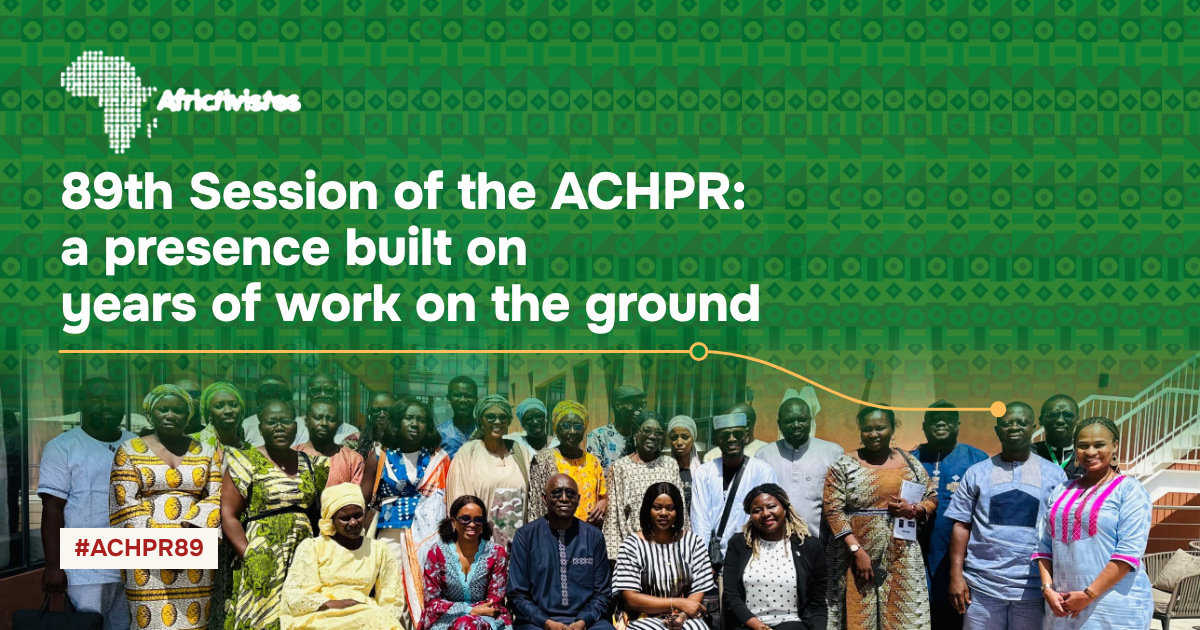
During the 89th Ordinary Session of the African Commission on Human and Peoples’ Rights (ACHPR), held in Dakar from 12 to 21 October 2026, AfricTivistes brought its communities’ concerns before the Commission. This presence was not built in the space of a single session. It rests on programmes run over several years with citizens, activists and human rights defenders across the continent.
It all started beforehand, with a new pan-African citizen consultation launched by AfricTivistes in September to bring African citizens’ concerns before the ACHPR. From 16 September to 12 October, citizens, activists and defenders shared their findings and recommendations on six themes: civic space, digital rights, access to justice, citizen participation, African protection mechanisms and the protection of young women leaders in social movements. AfricTivistes’ communities took it up: the Sahel Activistes, members of the CitizenLabs and young changemakers supported by its programmes shared their experiences and mobilised those around them. The consultation remained open throughout the session.
Carrying communities’ voices
In October, Dakar moved to the rhythm of the ACHPR session, which opened under the banner of the 40th anniversary of the African Charter on Human and Peoples’ Rights. AfricTivistes carried its communities’ voices there by co-organising three meetings and, from the NGO Forum onwards, taking part in several panels and partner events.
The first of these meetings took place on 13 October: the Senegal National Stakeholder Forum on the Operationalisation of the ECOWAS Economic, Social and Cultural Council (ECOSOCC-West Africa), co-organised with the West Africa Democracy Solidarity Network (WADEMOS) and the West Africa Civil Society Institute (WACSI). The forum recalled a promise that has remained on paper: the 1993 Revised Treaty of the Economic Community of West African States (ECOWAS) provides for an Economic and Social Council to give non-state actors a place in regional decision-making. More than thirty years on, this Council still does not exist.
For Cheikh Fall, President of AfricTivistes, the Council already exists in practice, through the expertise that organisations such as WACSI, WADEMOS and AfricTivistes bring to ECOWAS. The challenge now is to institutionalise it: “We must go beyond ideas alone; we must identify the levers to put them into practice.” Paul Osei-Kuffour, Coordinator of WADEMOS, called for a shift from an ‘ECOWAS of States’ to an ‘ECOWAS of the people’. At the close of the forum, the ECOWAS Club Senegal committed to joining the campaign for the Council’s operationalisation.
The second meeting took place on 15 October on the theme ‘Meeting the Moment: Protecting Young Women Leaders in Social Movements’. It was organised with the African Women Leaders Forum (AWLF), Demos Kratos and AfricanDefenders. Prepared through two webinars and contributions to the consultation, it brought some twenty young women leaders of social movements into direct dialogue with Commissioner Rémy Ngoy Lumbu, the ACHPR’s Special Rapporteur on Human Rights Defenders. Their message was clear: the way Africans exercise their rights has changed, increasingly through social movements and informal groups, and the Commission’s procedures need to catch up.
Activists from Senegal, Uganda, Mozambique, Kenya and Eswatini, among others, spoke about their engagement, their place within these movements and the strategies they develop in the face of pressure, online and offline. They also questioned the rule requiring the exhaustion of domestic remedies before national courts that are often far from impartial.
Commissioner Lumbu acknowledged that some States Parties are themselves among the perpetrators of violations. Violations must first be documented and brought before national courts, he recalled, but a formal complaint is not the only route: individuals and groups without observer status can report violations directly to the Commission and its special mechanisms. Aisha Dabo, Programme Coordinator at AfricTivistes, made the same case for non-conventional movements: “We must move from lived experiences to strong recommendations for the Commission.”
Finally, participants put forward recommendations for the Commission: regional protection mechanisms better suited to women’s realities, simpler procedures, mental health support for women defenders and intergenerational dialogue to prepare the next generation of activists.
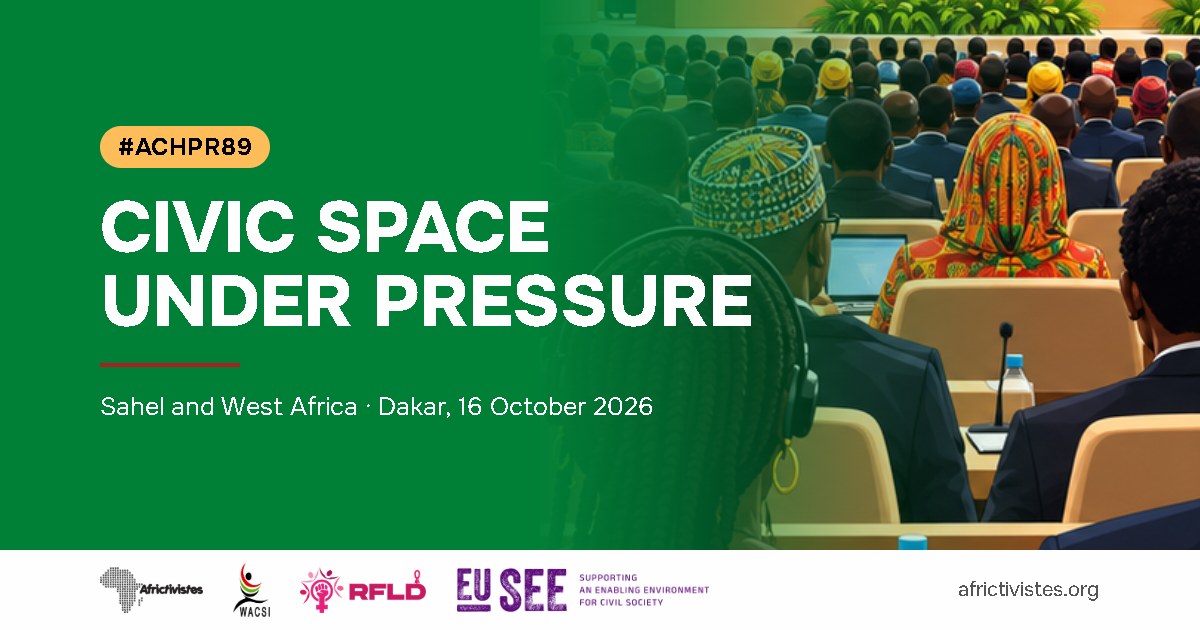
On 16 October, for the third and final meeting, AfricTivistes joined forces with the West Africa Civil Society Institute (WACSI) and the Réseau des Femmes Leaders pour le Développement (RFLD — Network of Women Leaders for Development). The three organisations brought together defenders, lawyers and journalists around the theme ‘Civic Space Under Pressure‘, focusing on freedom of association and the judicialisation of civic action in the Sahel and West Africa.
The meeting illustrated, through concrete cases, what actors in the region are going through: the dissolution of organisations, the persecution of exiled defenders’ families, legal proceedings used to intimidate, pressure extending even to partners abroad and political influence over the judiciary. It resulted in seven recommendations addressed to the Commission and to States:
- facilitate access to observer status with the ACHPR;
- institutionalise protection mechanisms for defenders;
- facilitate access to remedies;
- strengthen follow-up on recommendations and decisions;
- protect victims, their families and their sources;
- make judicial independence a regional priority;
- investigate reprisals.
These recommendations underline the role civil society plays alongside the Commission. As legal expert and human rights defender Ibrahima Kane put it, “If the African Commission is what it is today, it is thanks to civil society.”
Before the Commission
On 13 October, during the public session on the human rights situation in Africa, WACSI and AfricTivistes presented a joint statement against the judicialisation of civic space in West Africa. It calls on States to take five concrete steps:
- reform restrictive laws that criminalise legitimate expression, association and peaceful assembly;
- end arbitrary detention and enforced disappearances, and investigate allegations of torture;
- guarantee judicial independence and the right to a fair trial;
- prevent the arbitrary suspension or dissolution of civil society organisations;
- strengthen the protection of defenders, particularly women defenders, against digital attacks and transnational reprisals.
It also asks the Commission to implement Resolution 667 on strategic lawsuits against public participation (SLAPPs) through a participatory study. For both organisations, “civic space is not a privilege granted by governments”.
On panels and at partner events
The work began even before the session opened. On 9 October, at the NGO Forum, Aisha Dabo took part in the panel ‘Digital Rights and Youth Participation at the Crossroads of Three African Union Conventions’, organised by Youth Democracy Cohort and the European Partnership for Democracy. She presented the recommendations of the Digitalise Youth consortium: in her view, young people must move from being voices that are heard to being actors who shape decisions. On the sidelines of the same forum, AfricTivistes took part in a side event by Tournons La Page on the instrumentalisation of young people in Burundi and the memory of victims in Guinea, with a shared conviction: documenting is already a way of fighting impunity.
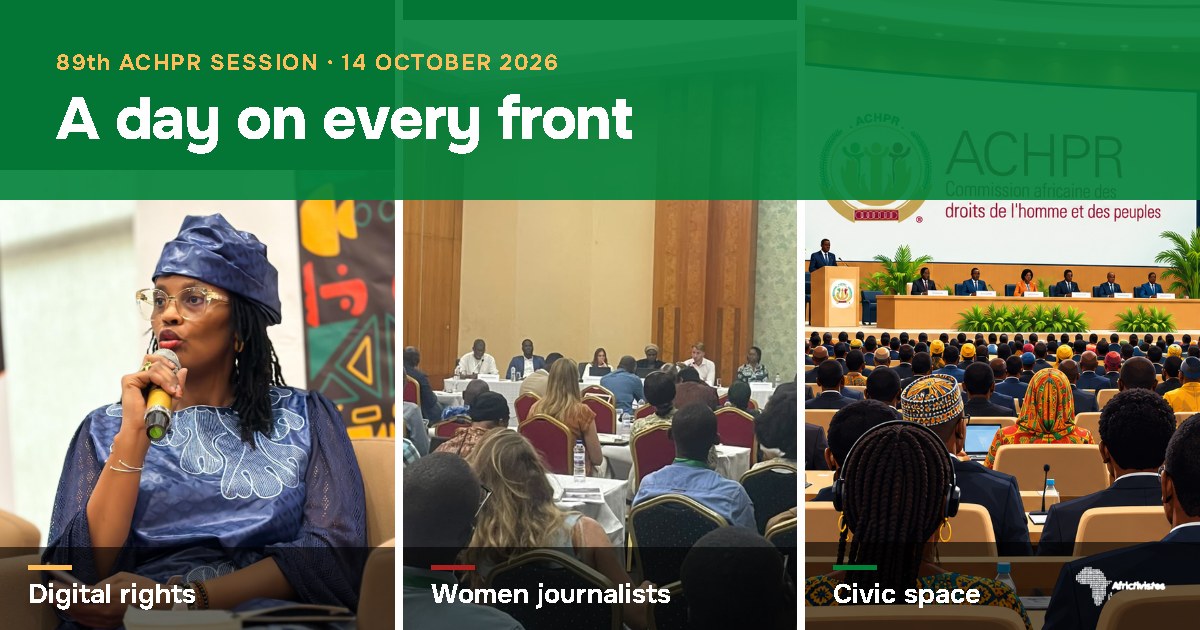
During the session, on 14 October, Aisha Dabo spoke on the panel on emerging technologies and human rights organised by AfricanDefenders and DefendDefenders. She argued that digital rights should be treated as a subject in their own right, with a permanent monitoring framework within the Commission. The same day, AfricTivistes attended the launch of the report by Lawyers Without Borders Canada on gender-based violence against women journalists and women human rights defenders in Benin and Senegal. It also followed discussions on the closing of civic space in the Sahel, where a Burkinabè journalist forced into exile gave testimony.
Members of AfricTivistes’ communities were not to be outdone. Having contributed to the consultation online, some of them travelled to Dakar. Alongside the AfricTivistes team, they followed the Commission’s work in public session, from the launch on 13 October of the tripartite study on the challenges facing women’s and girls’ rights litigation before African Union human rights organs to the Joint Forum of the Special Mechanisms on 20 and 21 October. In particular, they attended the debates on the human rights situation in Africa, on the ratification of treaties and the implementation of decisions and on the activity reports of Commissioners and special mechanisms, as well as the examination of Guinea-Bissau’s periodic report. They also took part in discussions organised by the Konrad Adenauer Foundation on democratic governance and human rights in West Africa.
Before the Commission and partner organisations alike, they spoke first-hand about the realities in their countries. The voices gathered through the consultation therefore did not stay online: they were carried into panels, meetings, side events and plenary sessions, with a view to strengthening human rights, including digital rights, and building a more participatory democracy.
The programmes behind this presence
What AfricTivistes brought to Dakar stems from years of work with communities of human rights defenders, journalists, young people and civil society organisations, often in countries where civic space is shrinking. AfricTivistes’ 2025–2029 Strategic Plan organises this work around three choices: supporting civic engagement, putting technology at the service of democratic participation and producing knowledge from the field through training, research and documentation. The Dakar session showed these choices in action.
In the Sahel, this work began with Sahel Insight. Launched in 2022 to help reduce inequalities, the programme trained civil society actors in influence, civic engagement and digital campaigning. It gave rise to the Sahel Activistes community, all of whose members took part in the consultation by documenting the concerns of their countries.
The same commitment to working close to communities guides Digitalise Youth and the AfricTivistes CitizenLabs. The former builds the digital skills of young changemakers and civil society organisations in the face of shrinking civic space and disinformation. The latter, local civic hubs, connect these skills to the realities of their communities. At the ECOSOCC forum, one of their representatives shared reflections on the role of digital tools in citizen participation.
Elections and governance are another focus of the Strategic Plan. Here, AfricTivistes has developed its own initiatives: AHEAD Africa, launched in 2024 to strengthen electoral integrity and civil society capacity; the Sóobu and Farafina platforms; the Election Civic Tech Fund; and Jokkondiral. On the ground, these tools make it possible to gather data on citizens’ participation in democratic processes, identify the obstacles they face and draw concrete recommendations from them, such as those put forward during the session.
Finally, information remains a field of engagement in its own right. Dialogue Migration, an information platform on African migration, has for several years promoted balanced journalism on African mobility. Carried out with journalists and communities in several countries, this work makes it possible to gather reliable information, better understand the realities experienced by migrants and formulate recommendations for the rights of intra-African migrants.
From one programme to the next, the approach is the same: start from the field, document, then take what communities say to the institutions that can act.
The contributions gathered and the recommendations from the three meetings will feed into AfricTivistes’ continued advocacy before the Commission and States. The pan-African citizen consultation remains open: every contribution counts.