On the need to limit terms of office in Africa!

AfricTivistes is launching the “Mooc Fridays: Democracy, Elections and Governance in Africa” initiative. This is a series of webinars focusing on the various topics covered as part of its distance learning programme. The first session, led by distinguished experts, takes an in-depth look at the issue of term limits.
The podcast is below
“Term limits in Africa: what role for civil society?” This was the theme of the first panel discussion, moderated by Maurice Thantan, Project Officer at AfricTivistes, which attracted around fifty participants.
In his introduction to the webinar, Mr Thantan clarified that when we refer to a third term in this session, we are referring solely to presidential terms, which are the most high-profile and most likely to be subject to constitutional tinkering.
Within the framework of democracy, Maurice Thantan emphasises, a change of leadership at the highest level of government is a key feature. Unfortunately, he laments, it is evident across the continent that current practice does not always align with the principle of term limits designed to ensure a change of leadership at the highest level. That is why, he says, civil society organisations such as AfricTivistes have committed themselves to promoting and advocating for term limits in Africa. At the heart of our discussions, he explains, will be the role of civil society organisations in tackling this scourge. Furthermore, he adds, we will be discussing the contribution of young people to this struggle.
After introducing the webinar, Maurice Thantan gave the floor, in turn, to Prof. David Ekoué Dosseh, Coordinator of the national coalition ‘Tournons La Page’; Ms Lidet Tadesse, Associate Director at ECDPM; Mr Alexandre Lette, journalist and consultant on the Civic Tech project; and Mr Aubin Kpoviessi, Head of the ICT Division at Avrankou Town Hall in Benin.
Below are the panellists’ full remarks.
Professor David Ekoué Dosseh, Coordinator of the ‘Tournons La Page’ national coalition
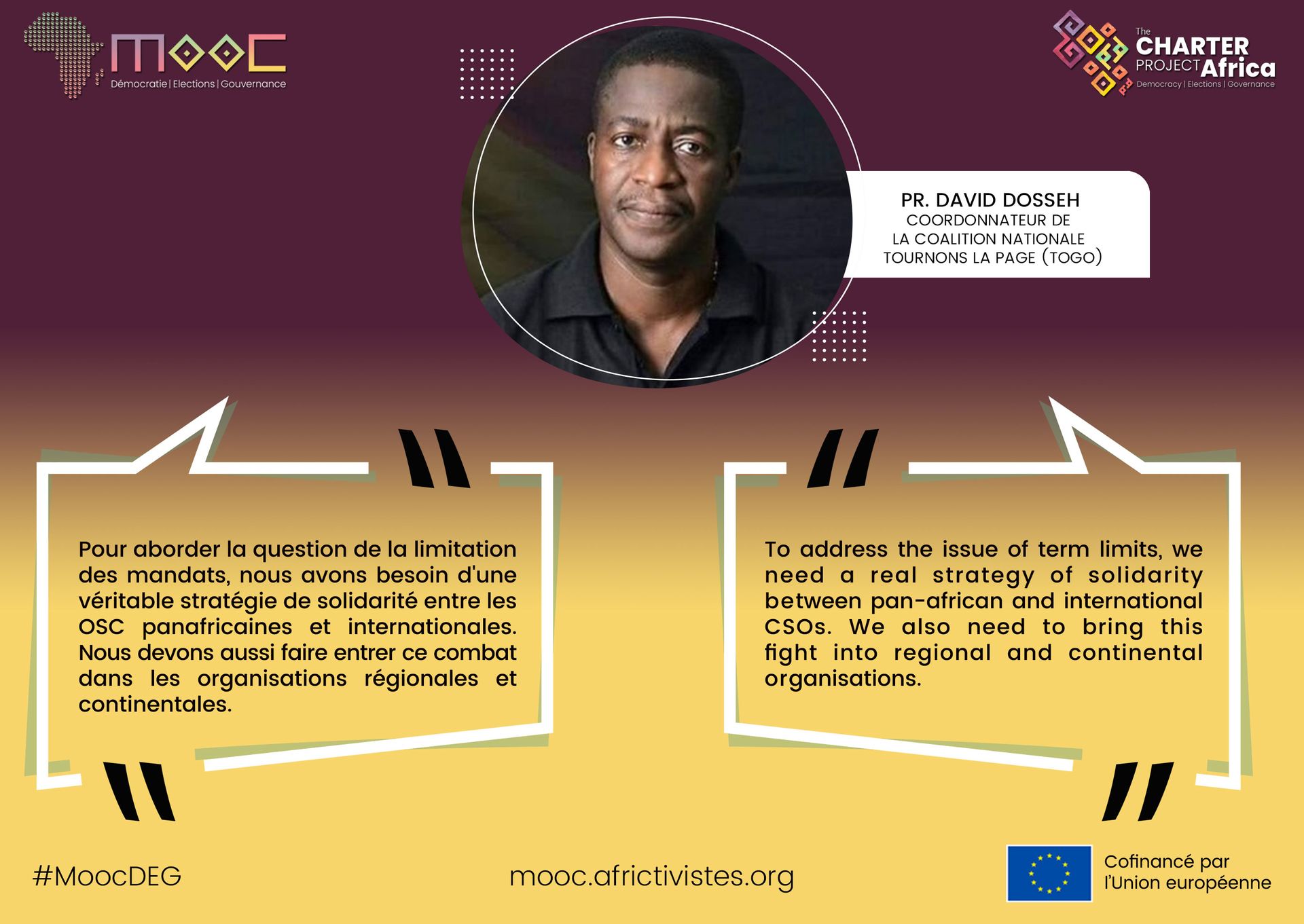
“We need a united strategy to defend term limits”
“This webinar provides an opportunity to discuss a crucial issue concerning the consolidation of democracy in Africa: that of term limits. Indeed, one might well ask why, in Africa today, imposing term limits can be seen as contributing to the consolidation of democracy. I believe the answer is simple. Firstly, we must recall the context of recent years, which has been characterised primarily by new strategies designed to enable the capture of political power. The architects of the current political regimes have found a way to retain power beyond the limits prescribed by the constitutions. And it is clear that regional institutions such as ECOWAS and continental ones such as the AU are failing to find an effective solution. (…)
The most distressing thing is that these new strategies for retaining and seizing political power lead to conflict. The National Democratic Institute (NDI) has done an excellent job in this regard, demonstrating that, apart from territorial disputes, major conflicts in Africa are linked to these strategies aimed at seizing political power. And these involve constitutional changes. They change a comma in the constitution, claim it is a new constitution and therefore a new Republic. They reset the clock so that a third term is treated as the first term of the new Republic. (…)
Another strategy is to draw up a new constitution tailored to a specific individual. This was the case in Togo in 2005. We saw the current President come to power through a coup. When his father died, the Constitution laid down very specific rules. The Speaker of the National Assembly was supposed to act as interim president until the next elections. But the military appeared on television to hand power over to him. After that, there were several constitutional shenanigans. The provisions of the Constitution were amended within the space of 24 hours. Several provisions were changed specifically to ensure that this new Constitution, which is being hastily drawn up, would grant the young President—who had benefited from the coup—the constitutional legitimacy required for his rule.
When we realise that these various strategies that have been put in place fail to provide appropriate solutions, but that they are in fact responsible for very serious and tragic socio-political conflicts affecting the people (as we have seen in Togo, Guinea, Côte d’Ivoire, Sudan, etc.), we must then seek a solution to limit presidential terms of office. We are aware that limiting presidential terms does not necessarily equate to democracy. However, given the context, it is important that we make it clear to the various heads of state and those in charge of political regimes that, however skilful they may be, once they take power, they must understand that they cannot exceed a limit laid down by the constitution. And so, this is what has led us to say that this must be our key priority.
A distinction is often drawn between the French-speaking and English-speaking worlds. Among English-speaking countries, there is a perception that they are far more advanced, with peaceful political transitions. Generally speaking, there is a sense that most English-speaking countries have already crossed this threshold. Efforts and resources are channelled into other issues, unlike in French-speaking countries, where we see many instances of heads of state remaining in office well beyond the limits of their terms. Examples of English-speaking countries include Ghana, Botswana and Nigeria…
However, in French-speaking countries, there are fortunately some states that save face. In Senegal, for example, there is a sense that there is a desire to seek a third term despite everything; yet it remains a sort of oasis of democracy or peaceful political change amongst French-speaking countries. Alongside Senegal, we can mention Benin. Then there are the Portuguese-speaking countries, such as Cape Verde, which is frankly a shining example of democratic political change.
It is now up to us, who are lagging behind, not to accept this situation and to do everything in our power to ensure that the principle of political alternation becomes a reality in our countries.
In the same way that heads of state (I’m not going to say that they form a union within the institutions; but there is certainly a sense of solidarity amongst them when one finds themselves in difficulty) receive support from other heads of state so that the strategy they have put in place to retain power can take root in one country, then in another, and so on. This is what happened in Togo. President Faure received support from President Alpha Condé. Then we saw Alpha Condé resolutely pursuing a strategy for a third term, and we saw where that led Guinea…..”
Ms Lidet Tadesse, Associate Director at ECDPM
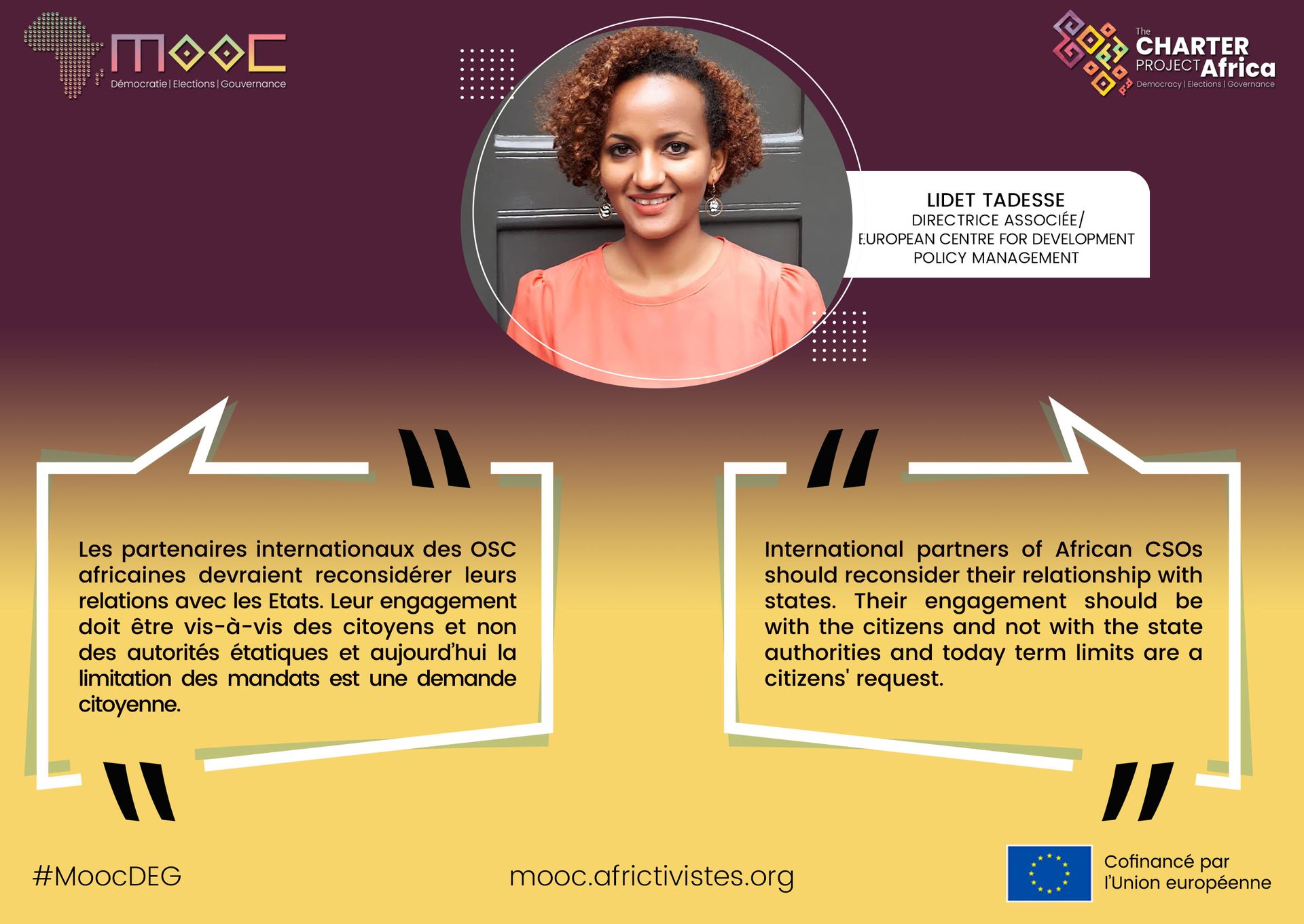
“The continent has no legislation governing term limits for presidents”
“When we talk about international actors and the role they might play, there are several things we should first take into account.
Firstly, we need to identify the national stakeholders who should be involved in addressing the issue of excessive terms of office, whether they be members of the public, civil society organisations, or judicial and legal institutions and bodies. We should, of course, also mention regional and continental institutions such as ECOWAS and the AU. (…) Not to mention the international partners who play a key role in these matters.
It should be noted that democratic governance is a goal to which all African countries should aspire. Several conventions drawn up by regional or continental institutions have been ratified by governments, such as the African Charter on Democracy, Elections and Governance, which governs elections, democratic culture and respect for democratic processes, as well as good governance in AU member states. However, this charter does not impose any limits on presidential terms of office.
Unfortunately, the continent does not yet have any documents at either the continental or sub-regional level that legislate on term limits for presidents. Therefore, at the level of the AU and regional organisations, there is, of course, agreement on democratic principles; and if we look at the African Governance Agenda (AGA) and the context in which it was implemented, the aim was to determine how to limit terms of office and enforce this principle in African countries in the late 1990s. Unfortunately, the member states had not ratified this clause. Several member states did not agree to have this term limit at the continental level.
But when we look at the continental level as a whole, and particularly at the structure of the AU, the Commissioner acknowledges and upholds the principle. So when we talk about democratic principles, they are implemented by continental actors, and at the diplomatic level, pressure is being exerted on national actors who champion democratic values. (…)
Furthermore, international actors who claim to uphold democratic values are guided by considerations other than democratic ones. These are often commercial, security or political considerations, and increasingly geopolitical ones. (…) There are many factors to take into account, and the answers are not always straightforward.
It should be noted that when we talk about international actors, we are really referring to a very diverse group. Some of them hold democratic values dear and uphold them through thick and thin. We can take the example of the EU, which is not very transparent in its practices. And adherence to foreign policy really dictates the EU’s decision-making.
Furthermore, there are other international players such as China, India, Turkey, … which are very important on the world stage today. And these players do not necessarily refer to democratic values in their foreign policies. Very often, it is a question of commercial or geopolitical interests. And they prefer not to interfere in other countries’ internal affairs. They are very explicit on this point, though sometimes a little less so. Because it is not very easy to take a stance on term limits for presidents. And so, in a way, even our discussions regarding term limits are only relevant in terms of the political agenda and values. (…)
To tell the truth, we should be supporting national institutions such as the judiciary and the legislature. We must also address the issue of term limits in political dialogue. Very often, international partners could work to ensure that these provisions are implemented, so as not to be accused of hypocrisy. And finally, civil society organisations should be involved so that they can participate and ensure that states do not exert pressure on these actors.
Ultimately, international actors might need to reconsider their involvement with governments that persist in breaching term-limit restrictions. (…)”
Mr Alexandre Lette, Journalist, Civic Tech Project Consultant
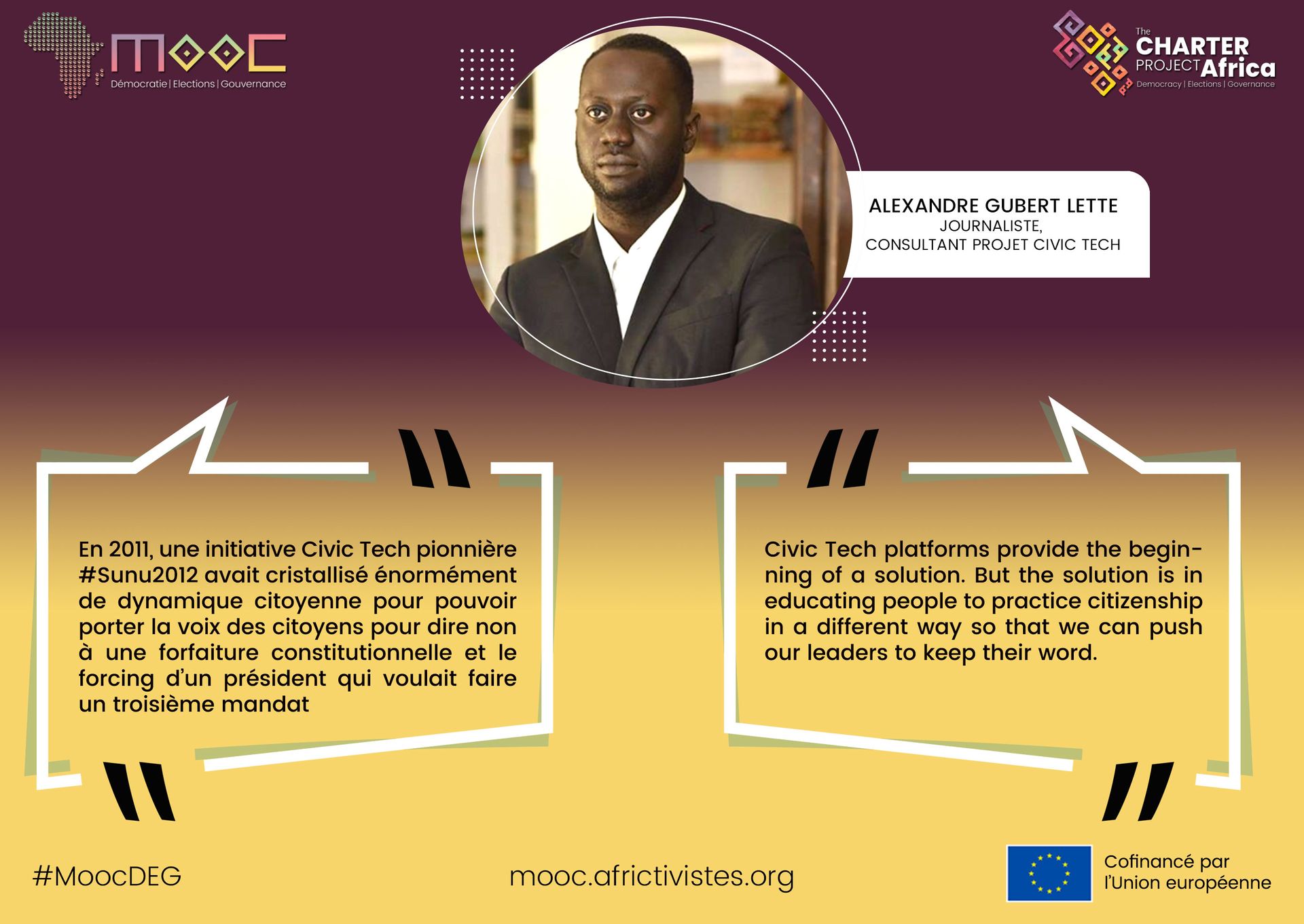
“Civic tech platforms offer a first step towards a solution, but they are not the solution on their own…”
“With the limited experience I have gained in the field of civic tech over the past ten years or so, I cannot recall, nor am I aware of, any specific initiative which, once launched, has managed to resolve the issue of term limits. However, civic tech offers the beginnings of a solution, as it is now helping to empower citizens and foster a better understanding of the democratic process within our communities. It is in this sense that the use of civic technologies is, in my view, essential. And by extension, the use of digital technology provides fertile ground for the emergence of a new civic consciousness.”
Digital technology now offers us a very important means of advocacy. Take the example of Senegal: in 2011, we were in a situation where the President wanted to serve an extra term. But I remember the role played by a pioneering Civic Tech initiative, #Sunu2012, which mobilised a huge amount of civic momentum to amplify the citizens’ voices in saying ‘no’ to a breach of the constitution.
And that is when we realise that digital technology, when used intelligently by communities and groups of people, can give rise to interesting projects. Seen in this light, one could say that Civic Tech may represent the beginning of a solution.
But this is not just about election monitoring, as is commonly seen in several countries across the continent with #SenegalVote, #BeninVote… There are also other initiatives to scrutinise government action and monitor the fulfilment of government promises, enabling the public to better understand the democratic process. It also enables decision-makers to listen to citizens and put a stop to certain attempts to tamper with the constitution. I like to cite the “Laidi” initiative launched by the Guinean bloggers’ association in a rather unusual context, as the platform did not prevent Alpha Condé from standing for a third term.
So you must agree with me that Civic Tech platforms offer the beginnings of a solution, but they are not the solution on their own. The solution lies in educating people about citizenship.
It also lies in the fact that the debate is framed in clear terms. As a young African, I am not one to worship figures. The problem lies in our leaders’ failure to honour their word and their habit of bending the rules at the end of their term of office to extend it for one term too many.
“To gain a better understanding of this issue, Civic Tech initiatives provide a way of raising public awareness of an alternative form of civic engagement.”
Mr Aubin Kpoviessi, Head of the ICT Division at Avrankou Town Hall in Benin
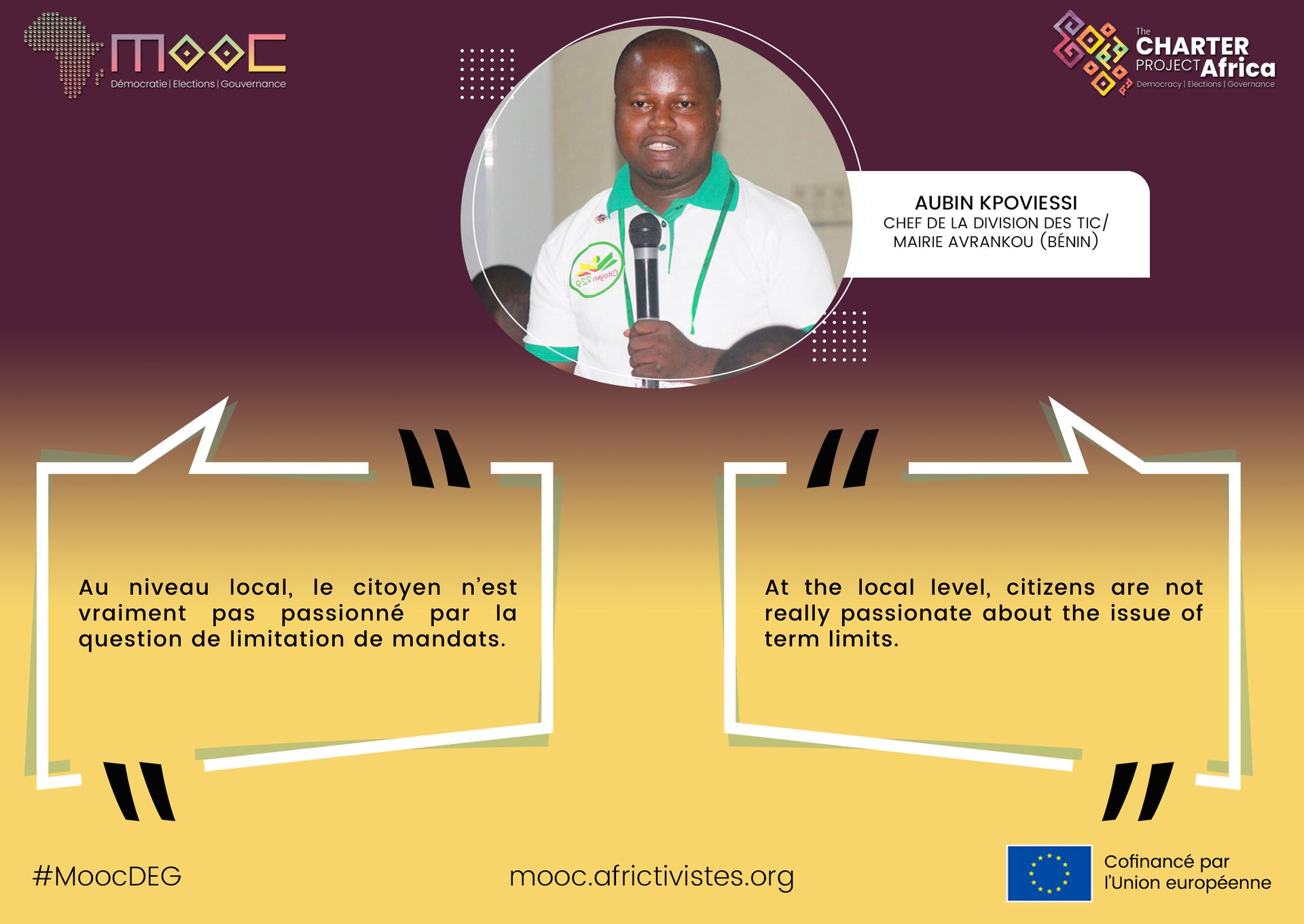
“The issue of term limits doesn’t really spark much interest at local level.”
“The problem runs rather deep in Benin. Because, up until now, no President has ever come forward to say that he intends to seek a third term. But at the end of every term, there have been suspicions. When Kerekou was finishing his second term in 2006, there were already calls for a third term as early as 2005. So much so that the “Don’t touch my constitution” movement led by Reckya Madougou (a Beninese opposition figure) was very successful. The same situation unfolded with Boni Yayi.
When the current President, Patrice Talon, wanted to stand for a second term, he amended the article limiting the number of terms – not with a view to allowing a third term in the future, but to restrict the number. The constitution now stipulates that no one may serve more than two terms. But before that, there was a legal vacuum. You could serve one term, take a break, and then return to serve a second term. Now, following the constitutional amendment of 2019, no President may serve more than two terms.
The same applies at local level: MPs may not serve more than three terms of office. Previously, MPs were elected for a four-year term, renewable for life. However, unlike local councillors, there is no limit set for them. The matter is therefore settled at national level, as even an MP elected in a particular locality is, first and foremost, a representative of the people.
At local level, the public is not particularly passionate about the issue of term limits. As long as they have enough to eat and live in peace, they are content. Even if they do take a stand on this issue, it is often because it has been exploited by the opponents of the incumbent local councillors.
“Now, when conflicts arise and people complain about a president serving too many terms, it can start to attract attention at a local level. Otherwise, this issue doesn’t really get people involved.”
This first webinar, which was rich in discussion, insights and recommendations, was attended by around fifty people from civil society organisations, the media, netizens and web activists. It is worth noting that a significant proportion of the participants were learners on the MOOC “Democracy, Elections and Governance”.
We look forward to seeing you on 12 August 2022 for another “DEG MOOC Friday”, which will focus on Civic Tech and Citizen Participation.